
What does a headline forecast of a 23% rise in commodity prices actually tell us? On the World Bank Group’s own evidence, published on October 28, 2026, it tells readers less about what will certainly happen than about how exposed the world economy remains if several shocks persist at once.
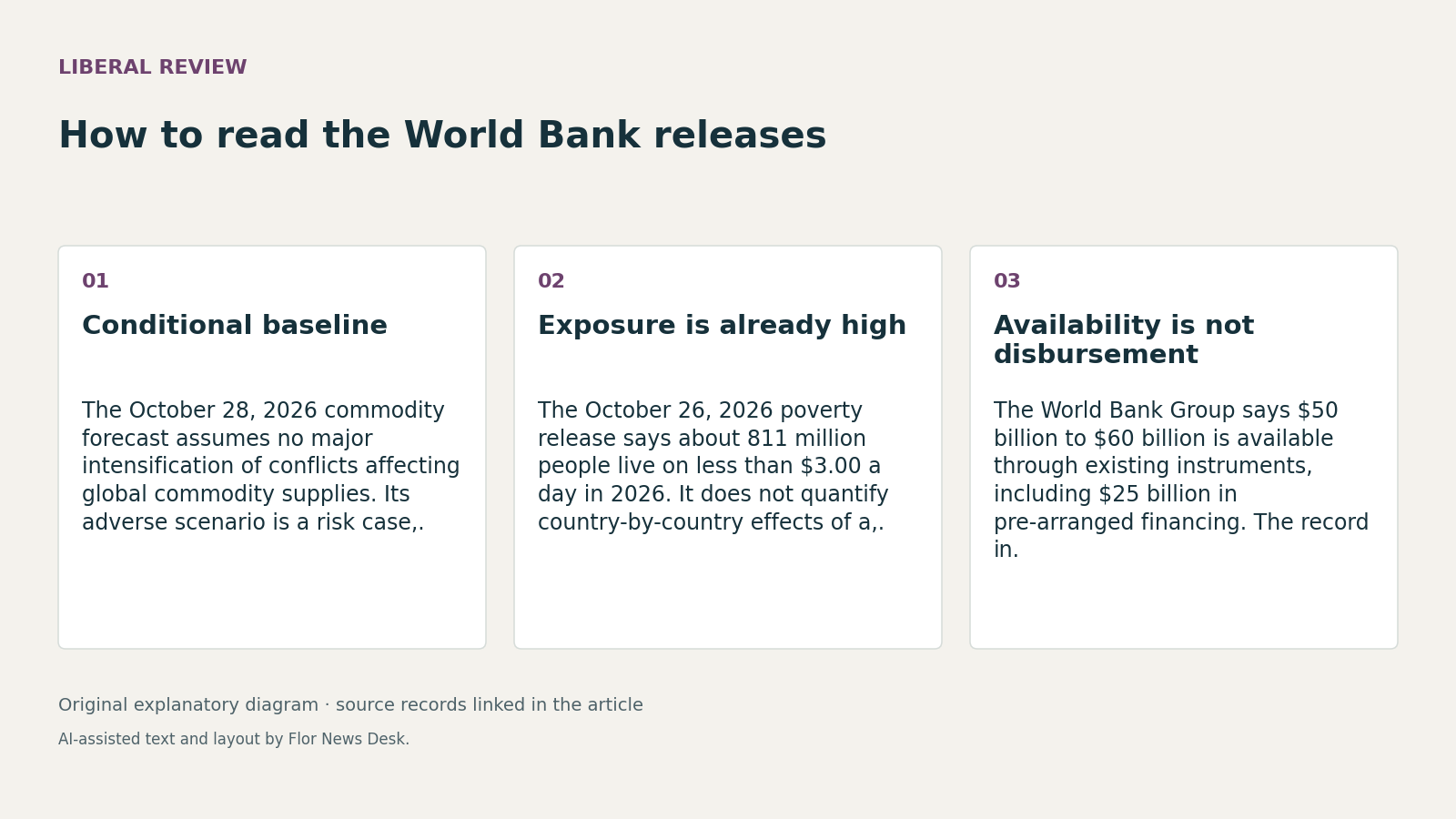
In its October 28, 2026 Commodity Markets Outlook release, the World Bank Group said overall commodity prices are forecast to rise 23% in 2026, with energy up 32%, metals up 25%, fertilizer up 14%, and food commodity prices up about 10% in 2026 and another 7% in 2027. Brent crude, it said, is projected to average $91 a barrel in 2026, up from $69 in 2025, before easing to $79 in 2027. Those are large numbers, but they are not measurements of a completed year. The same release says the forecasts assume no major intensification of conflicts affecting global commodity supplies.
That conditionality matters because the Bank’s other releases describe a world with limited social margin for error. In a separate October 26, 2026 poverty release, the World Bank Group said about 811 million people in 2026 live on less than $3.00 per person per day, and projected that by 2030, 87% of the extremely poor will live in Sub-Saharan Africa or in fragile and conflict-affected situations. That does not prove how a commodity spike would translate into poverty in any named country. It does show that a price shock would hit a global economy in which poverty reduction has already stalled.
The food numbers sharpen the point. The commodity release says food prices are expected to rise about 10% in 2026 and another 7% in 2027, a cumulative 18% across the two years. It also describes an adverse scenario in which higher-than-expected energy prices, attacks on Black Sea grain shipments and a very strong El Niño coincide, pushing food commodity prices in 2027 to 12% above the baseline forecast. That is a risk pathway, not a demonstrated outcome. The release does not quantify retail food-price pass-through, malnutrition, unrest or fiscal stress country by country.
The financing language also needs careful reading. The October 28 release says the World Bank Group has made $50 billion to $60 billion available through existing instruments, including $25 billion in pre-arranged financing, to support social safety nets, fiscal capacity, and liquidity or working-capital support. That establishes institutional capacity to offer support. It does not identify approvals, recipient countries, allocations, drawdown dates or disbursements.
A useful correction is needed on the energy side. The October 27, 2026 off-grid solar release does not prove that energy-resilience funding is currently falling short by a measured amount. What it does say is narrower and still important: the World Bank Group’s Energy Sector Management Assistance Program and GOGLA reported that off-grid solar is the least-cost option for at least 398 million people without electricity, that users rose from 118 million to 149 million over the past two years, that World Bank Group commitments to off-grid solar reached USD 974 million in FY25–26, and that reaching the identified potential by 2030 would require around USD 11.4 billion in public and private investment between 2027 and 2030. Those figures cover different actors and time periods, so they are not a simple delivered-versus-needed ledger.
Taken together, the three releases still support a clear question for politics. Can conditional warnings be turned into actual protection before they become observed damage? On the present record, the World Bank Group has described a plausible commodity shock, a world of stalled poverty reduction, and financing it says is available. But these are institutional press releases, not recipient-level finance records or observed 2026 outcomes. The strongest conclusion, therefore, is not that a 23% rise settles the future. It is that the Bank is warning how little room many households and governments have if its baseline, or something worse, begins to materialize.
Read our editorial standards or send a correction to the editorial desk.