
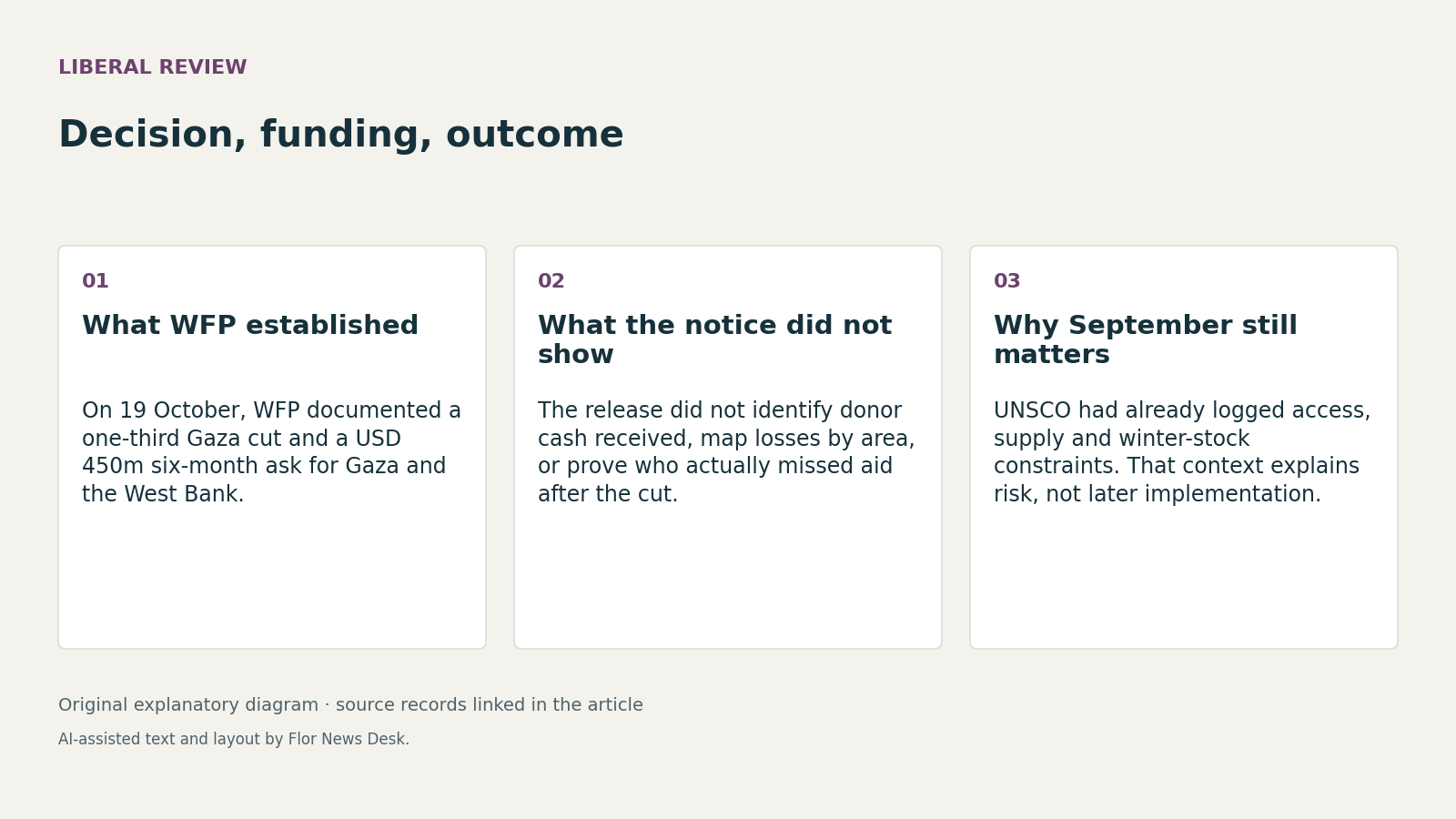
On 19 October 2026, the World Food Programme made a claim that matters because it is operational, not merely rhetorical: funding shortages had forced it to cut Gaza assistance by about one-third, leaving around 500,000 people without aid in October after the agency’s monthly caseload fell to 1.1 million from 1.6 million in September. WFP also said it had halved rations, reduced hot meals to 150,000 a day from 250,000, and cut cash-assistance value for 75,000 families. That is enough to establish a documented policy shift inside one of the central aid systems in Gaza. It is not enough to establish how the shift will land on the ground. WFP press release
The most useful distinction for readers is between an announced cut and a measured outcome. WFP’s notice shows the agency’s intended reduction, and it names an urgent need for USD 450 million to maintain critical operations in Gaza and the West Bank from October 2026 to March 2027. But the same public page does not identify which donors have paid, which may only have pledged, or how much money has actually reached WFP accounts for this period. It also does not break down the 500,000 figure by governorate, camp, family size or aid modality. So the headline number is real evidence of a decision, but not yet public evidence of its distributional pattern or its final humanitarian effects. WFP press release
That gap matters because the September 2026 context already described a system constrained by more than money alone. The Office of the United Nations Special Coordinator reported on 24 September 2026 that around two-thirds of Gaza remained inaccessible or under severe access restrictions, that humanitarian actors faced access, supply and funding constraints, and that the 2026 Flash Appeal was 40 percent funded. In that setting, even a fully financed food plan would still face delivery barriers; conversely, a funding cut may hurt different places differently depending on where access is possible. The policy question is therefore not just how much WFP lacks, but how finance and access interact. UNSCO report
The winter argument is similar. UNSCO said winterization plans were in place in September, but that shelter and non-food stocks were depleted, that entry constraints on critical items continued, and that funding remained critically low. That does not prove what happened after 24 September, and by 25 October 2026 it should not be read as a live forecast automatically fulfilled. What it does show is why the timing of WFP’s 19 October cut is politically sharper than a routine budget shortfall: food reductions are arriving against a documented backdrop of depleted stocks and constrained humanitarian entry. UNSCO report
There is also a broader analytical point. Humanitarian announcements often compress three separate questions into one number: what an agency plans to do, what it can pay for, and what it can physically deliver. The WFP notice gives readers unusually concrete planning figures. UNSCO supplies the structural reasons those figures may not translate cleanly into outcomes. The public record here therefore supports a narrower but more rigorous conclusion than sweeping commentary often allows: a major UN agency has formally reduced Gaza assistance in October 2026, and the scale of the reduction is documented; the public documents reviewed here still cannot show which communities will lose the most, whether donors can reverse the cut quickly, or whether access restrictions will make even restored funding insufficient. WFP press release UNSCO report
Read our editorial standards or send a correction to the editorial desk.
