
The most important point in the new climate paperwork is not that finance and emissions can already be neatly compared. It is that they cannot. On 21 October 2026, a United Nations news report summarizing UNEP’s *Emissions Gap Report 2026* said a 1.5°C overshoot is now expected, and that UNEP’s lowest-overshoot pathway would still require emissions cuts of 18% by 2030, 45% by 2035 and 69% by 2040, all relative to 2025 levels. The same UN page said current policies imply 2.8°C warming this century, while delivery of all NDCs plus similar continued effort would limit warming to 2.6°C (UN News, 21 October 2026).
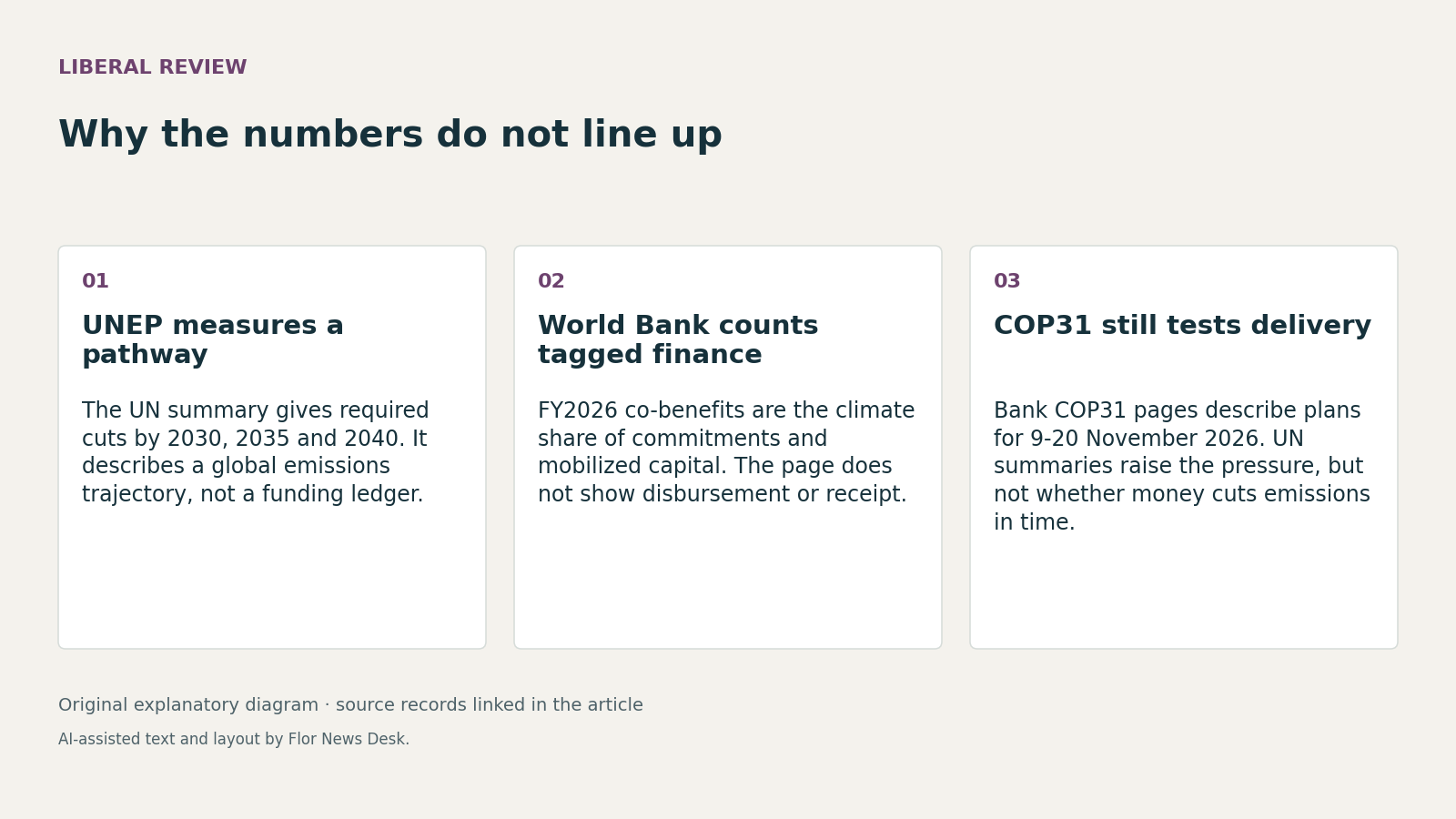
That is a pathway claim: a timetable for how fast global emissions must fall. It is not, by itself, a financing plan. A separate UN press briefing on 21 October 2026, explicitly labeled a public preview created with automatic speech recognition rather than an official UN record, framed the politics more bluntly: the spokesperson said the Secretary-General viewed 1.5°C with no or limited overshoot as no longer attainable, while still arguing temperatures could be brought back below 1.5°C before century’s end if governments moved much faster. In that briefing, the Secretary-General also called for G20 leadership and affordable finance for developing countries (UN briefing transcript). The analytical point is simple: finance appears here as a condition for a pathway, not as evidence that the pathway is being met.
On 28 October 2026, the World Bank Group published a very different kind of number. Its climate finance update said it delivered $48 billion in own-account climate co-benefits in Fiscal Year 2026, equal to 44% of total commitments, and also mobilized $48 billion in private capital with climate co-benefits, for a combined $96 billion in climate-related financing, 21% above FY25. The same factsheet said $15 billion supported adaptation, or 31% of World Bank Group climate co-benefits, and that 51% of climate co-benefits in IDA countries supported adaptation (World Bank climate finance update).
Those figures matter, but their meaning is narrower than the headline suggests. The World Bank says climate co-benefits are the climate-relevant share of a development investment, not a separate pool of finance (World Bank climate finance update). The same page says the active portfolio is expected to help 465 million people become more resilient to climate risks and contribute to 345 million metric tons of CO2 equivalent in net emissions reductions per year, yet it presents those as expected portfolio effects, not measured outcomes, and it does not separate approval, commitment, disbursement and receipt (World Bank climate finance update). So the update cannot show, on its own, whether money has reached the places and sectors where UNEP’s timetable requires cuts before 2030.
That definitional mismatch is exactly what COP31 will have to confront. The World Bank Group’s COP31 page says it plans to attend the Antalya summit from 9 to 20 November 2026 and intends to present financing, knowledge, guarantees and private-capital mobilization around jobs, resilience, energy, water and food security, and growth (World Bank at COP31). As of 1 November 2026, that page is evidence of plans, not summit outcomes. Meanwhile, the UN News summary linked UNEP’s warning to the second Global Stocktake at COP31 (UN News, 21 October 2026).
There is also a source-record warning here. The UN climate reports hub available in this brief groups relevant material, but the dated list visible there points to WMO updates and UNEP’s 2024 *Emissions Gap Report*, not the 2026 UNEP report text or methods (UN climate reports hub). That does not invalidate the UN summaries; it limits what they establish. The strongest reading, then, is narrower than either headline alone: UNEP defines the speed of the emissions task, and the World Bank reports a larger volume of climate-tagged commitments and mobilized capital. Neither record, by itself, proves that near-term finance flows are aligned with the cuts UNEP says are now required.
Read our editorial standards or send a correction to the editorial desk.