

The strongest case in these records is not that Latin America and the Caribbean have suddenly discovered digital government. It is that, by 2022, much of the region already had the basic administrative machinery in place. The harder question now is whether those systems can support public accountability rather than simply record transactions.
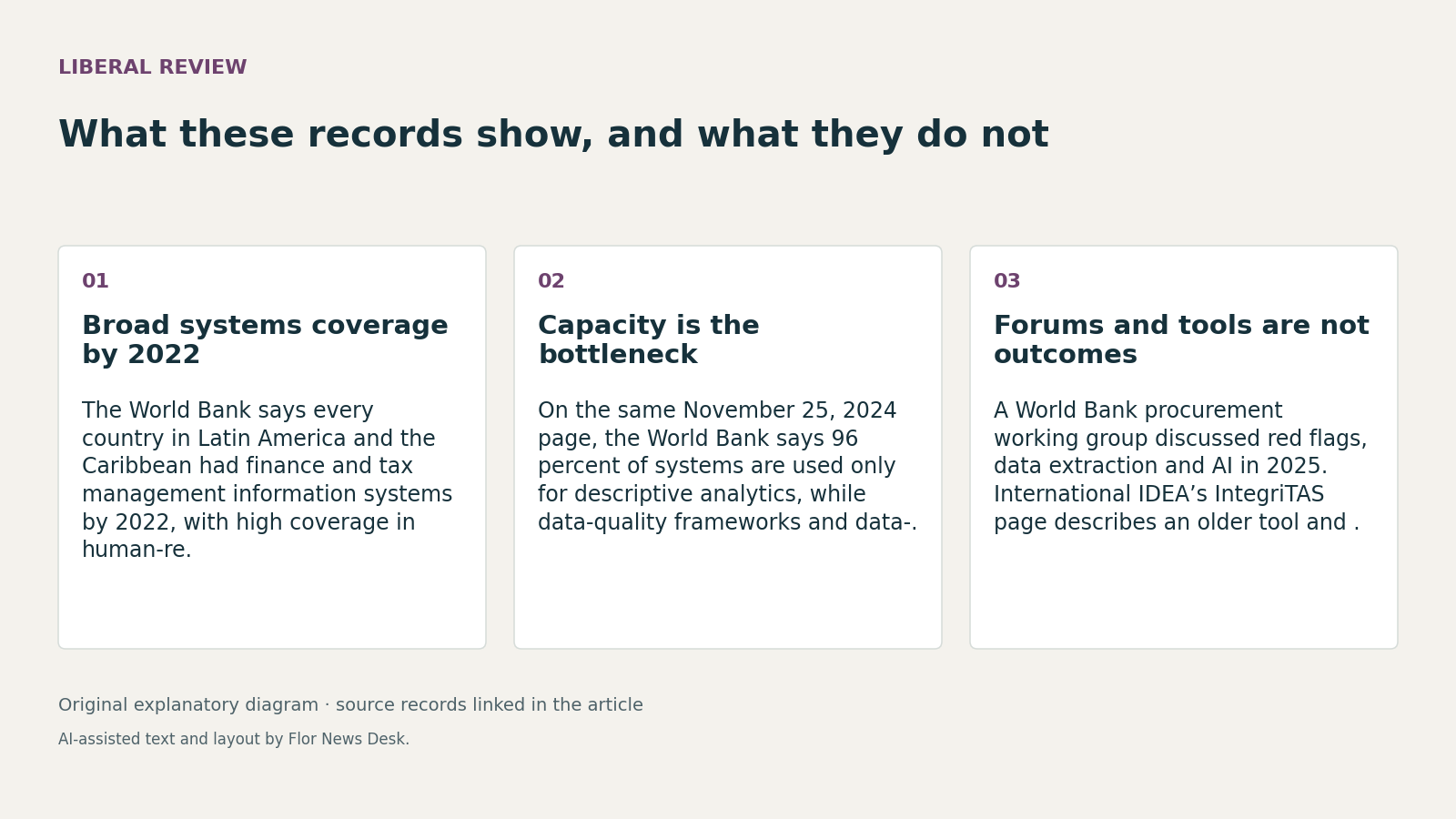
That narrower claim is supported by the World Bank’s overview, published on November 25, 2024: by 2022, every country in the region had both a Public Finance Management Information System and a Tax Management Information System; 91 percent had a Human Resources Management Information System; and 84 percent had an e-Procurement system, according to the World Bank overview. Those figures matter because they shift the debate. In this source record, the region’s problem is less the absence of state data systems than the limited public use made of them.
The same page is also the main reason for skepticism. The World Bank says 96 percent of management information systems in the region are used exclusively for descriptive analytics, two-thirds of experts surveyed report that those systems remain only partially digitalized, only 25 percent of countries have implemented a data quality framework, and only 12 percent of public administrations offer a dedicated career path for data analysts on the same page. That is a substantial correction to any triumphalist story. Data coverage is not the same thing as interoperable records, validated indicators or officials with enough standing to act on a warning.
Procurement is where the gap becomes easiest to see. On its Working Group on Anticorruption in Procurement page, the World Bank says the group is hosted by the bank and co-chaired by the Open Contracting Partnership and Government Transparency Institute. The first meeting, on September 18, 2025, discussed data standardization across countries, data extraction, capacity gaps, red-flag systems, and the potential use of AI and large language models on unstructured documents. The second, on December 10, 2025, discussed red-flag systems and integrity measurement in public procurement. That supports a real institutional agenda around analytics. It does not, however, show budgets, binding commitments, implementation records or measured savings.
The page also illustrates why date discipline matters. Retrieved on November 2, 2026, it still said the third meeting, “On March 18, 2026,” participants “will discuss” procurement integrity efforts in several African countries and Guatemala. That stale future tense is not evidence that the meeting happened, nor of what followed.
International IDEA’s Sistema de evaluación de amenazas IntegriTAS belongs in this story only in a limited way. International IDEA describes it as a digital system for assessing threats of political corruption linked to organized crime, with mapping, geo-referencing, trend charts and early-warning alerts. But the same page shows related publications dated May 9, 2018, and its access terms are narrower than the earlier draft suggested: users must register prior interest, and International IDEA says a “genuine and non-for-profit organization” will be granted a download key upon request. The page does not establish deployment in Latin America and the Caribbean, scale of use, or independent validation.
There is still a serious argument for urgency. The World Bank says inefficiencies in procurement, misdirected transfers and poorly managed human resources amount to waste equal to 4 percent of GDP and 17 percent of public spending in the region on its November 25, 2024 overview. But this source set supports a narrower conclusion than the original draft claimed: the region has broad digital administrative infrastructure, and reform institutions are discussing more ambitious analytical uses for it. What these records do not yet show is who funded the next step, which tools were independently validated, where threat-mapping software was actually deployed, or what happened when the systems flagged abuse.
Read our editorial standards or send a correction to the editorial desk.