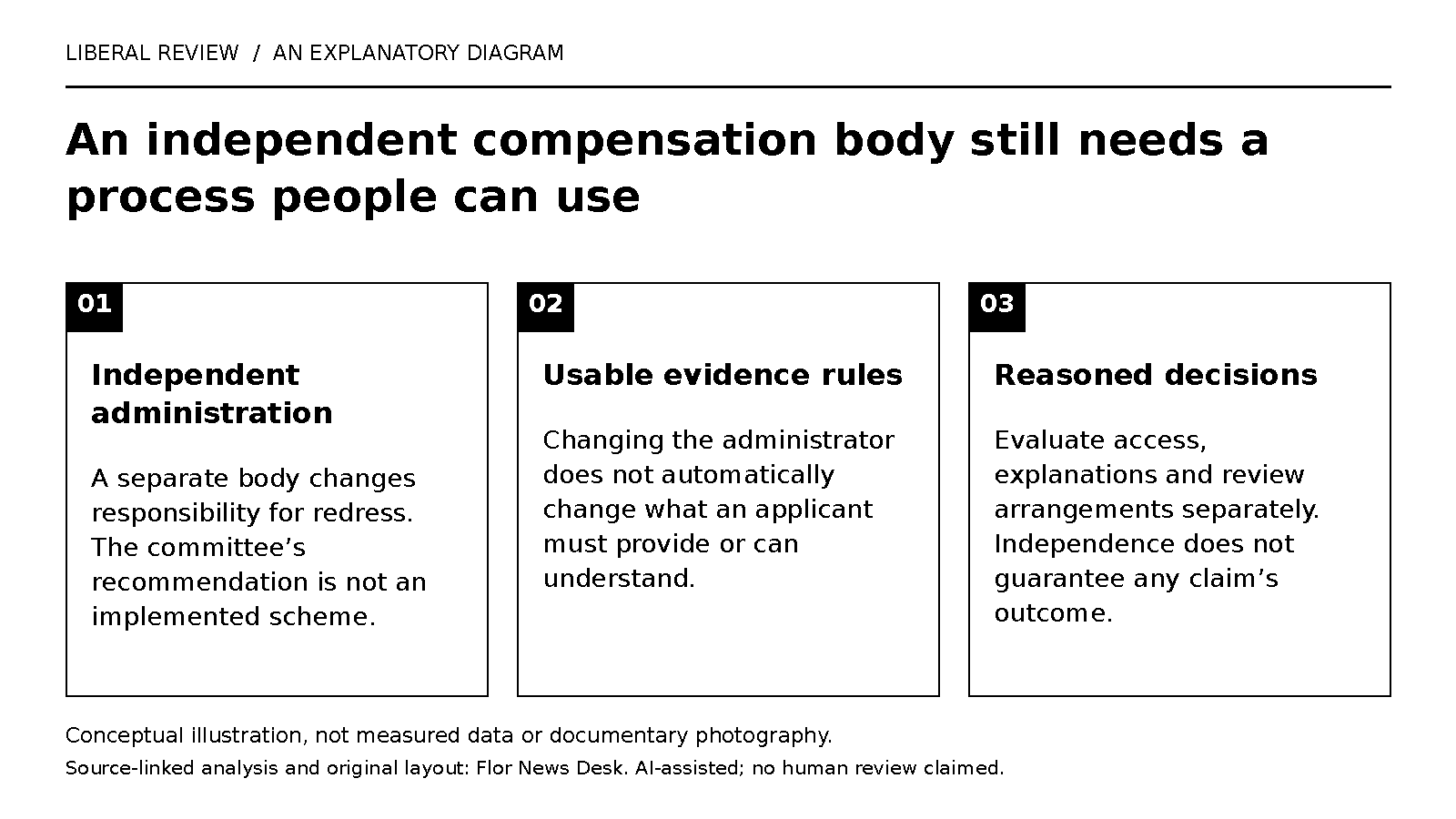
Moving compensation decisions away from the public body responsible for harm addresses an important institutional question. It does not, on its own, specify an accessible claims process. The Public Accounts Committee’s September 9, 2026 report calls for an independent body to design and administer government compensation schemes. That is a proposal to change the administration of redress, not evidence that a new body has already been established.
The distinction deserves attention because independence can describe an organization without describing the experience of applying to it. Who appoints the decision-maker and what evidence an applicant must supply are related questions, but answering the first does not answer the second.
Separation is a beginning
The committee’s published account of its findings identifies difficult evidence requests, poor communication and delays among the problems raised through its inquiry. Its survey records the experiences of respondents; it is not a representative estimate of the experience of every claimant. The account also argues for involving affected communities in the design of schemes. These are attributed findings and recommendations, not independently verified results from a redesigned service.
The case for separation is therefore specific. A distinct administrator can be given a task that is not simply the defence of the original institution’s actions. But a change of administrator would leave important choices unresolved unless the new body’s responsibilities, resources and decision procedures were also made clear.
Suppose, as a hypothetical example, that a scheme changes its organizational home while retaining exactly the same evidence requirement. An applicant unable to meet that requirement would still face the same evidentiary obstacle. This does not show that independence is pointless. It shows why independence and usability should be evaluated separately rather than making either stand in for the other.
A decision must be reachable and explainable
The next question is what a fair procedure should make intelligible. An applicant should be able to understand what is being assessed, why particular information matters, and how a decision is explained. A public account of a scheme should distinguish these procedural commitments from a promise that every claim will succeed.
There is also a legitimate need for consistent, accountable use of public funds. Accessibility cannot sensibly mean abandoning an evidentiary basis for decisions. The challenge is to justify the evidence sought in relation to the scheme’s purpose, rather than treating administrative difficulty as an unavoidable sign of rigour. That is an argument about design, not guidance on the validity of any individual claim.
Communication needs its own test as well. Sending an update, explaining what remains unresolved and setting a dependable timetable are different commitments. Recording the first cannot demonstrate that the other two have been fulfilled. Equally, uncertainty should be described honestly rather than hidden behind a date the administrator cannot support.
The committee’s proposal is best judged as the start of a design obligation. Independence can alter who carries responsibility for redress. The credibility of that arrangement would still depend on whether its procedures let people reach a reasoned decision, understand it and challenge errors through an appropriate route.
Read our editorial standards or send a correction to the editorial desk.