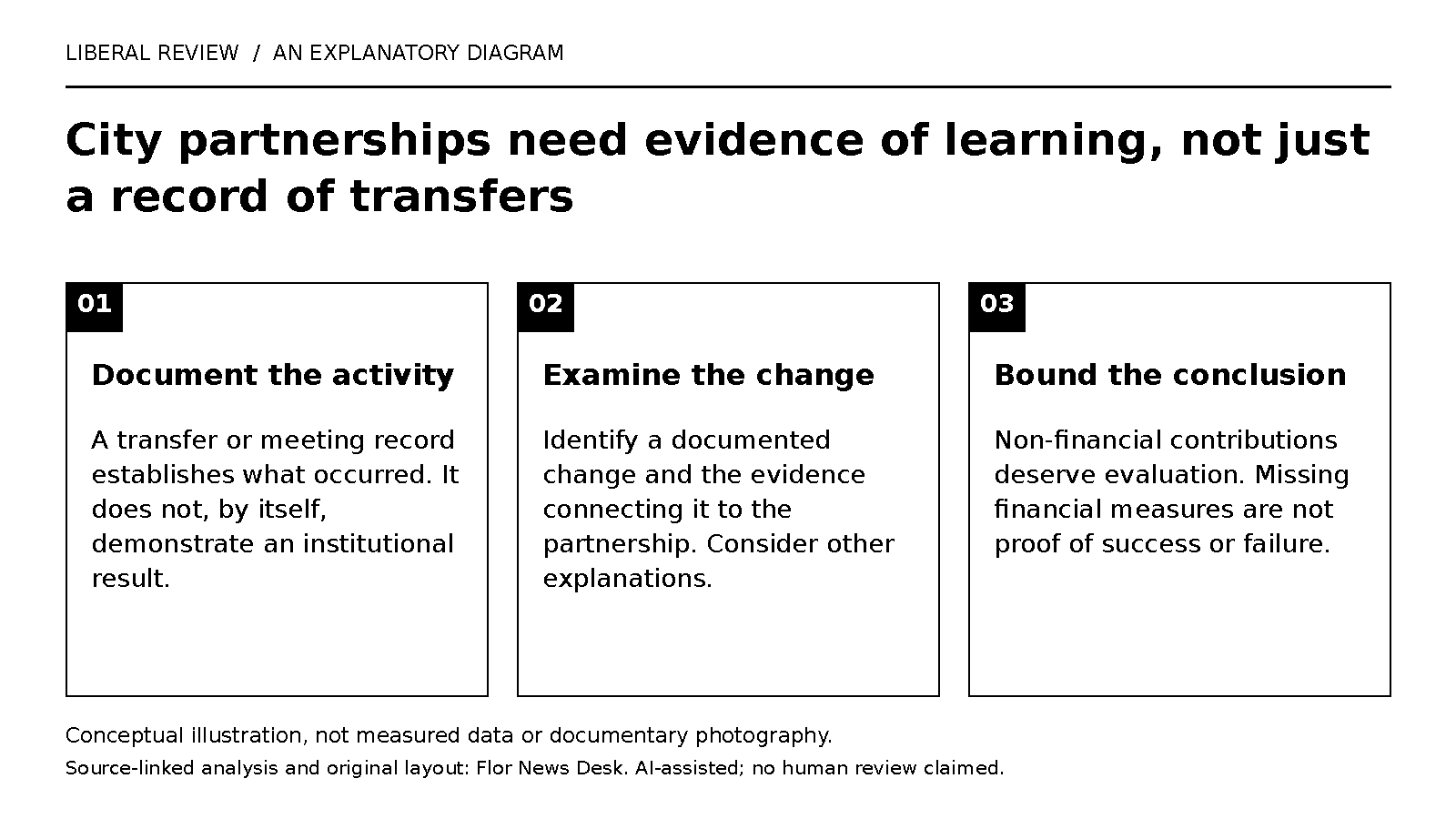
An international partnership between cities can involve money, professional exchange or both. Treating its financial record as a complete account risks missing the second contribution. Treating every exchange as a demonstrated success makes the opposite mistake. The OECD’s September 8, 2026 study of decentralised development co-operation offers a basis for keeping those questions separate.
The study brings together financial information, surveys and case studies. Those forms of evidence should not be collapsed into a single claim of impact. A record can establish that resources were transferred without establishing what an institution learned. A participant’s account can identify a perceived benefit without, on its own, isolating the effect of the partnership from other influences.
A contribution beyond cash
The report’s introduction and methodology defines this cooperation as activity led by subnational governments, including financial and non-financial support. It describes peer learning and knowledge exchange as part of the latter. These are the OECD’s descriptions of a form of cooperation, not evidence that any particular workshop has transformed a local service. The two sources belong to the same study rather than providing independent corroboration of an outcome.
This definition matters for public accountability. An activity need not appear as a cash transfer to deserve examination. But the absence of a suitable financial measure does not remove the need for evidence. It changes what evidence is relevant to the claim being made.
Imagine a hypothetical partnership in which officials compare approaches to a municipal process. A meeting record would document the exchange. A revised procedure could document a subsequent institutional change. Establishing that the exchange contributed to that revision would require an account connecting them. Establishing a resulting improvement in the service would be another question again.
None of those steps should be assumed merely because the earlier one occurred. Equally, failure to demonstrate the last step would not prove that the meeting never happened or that the participants learned nothing.
Learning without manufactured certainty
There is a reasonable concern that demanding a definitive causal estimate for every exchange could exclude contributions that are difficult to isolate. A useful evaluation need not respond with a false choice between a perfect experiment and an unexamined success story. It can state what changed, record the account of how it changed, and identify competing explanations or missing observations.
The same discipline applies to comparisons. A financial total covering a defined group of reporting governments and historical years cannot establish the full value of every partnership. Nor should non-financial cooperation be assigned an invented monetary value simply to make it fit that total.
The public argument for these partnerships is stronger when it recognizes this distinction. Local governments can explain why an exchange was undertaken and what evidence supports the benefits claimed, without suggesting that cooperation itself guarantees results.
A defensible account would therefore be neither a ledger alone nor a celebration of contact. It would connect resources, activities and documented institutional changes while leaving the limits of attribution visible.
Read our editorial standards or send a correction to the editorial desk.