A government can receive separate reports from every enterprise it owns and still need an account of how their exposures relate. The OECD’s Managing Risk Across State-Owned Enterprises, published September 15, 2026, examines that ownership-wide perspective. Its concern is not simply whether individual companies have controls, but how the public owner understands risk across its portfolio.
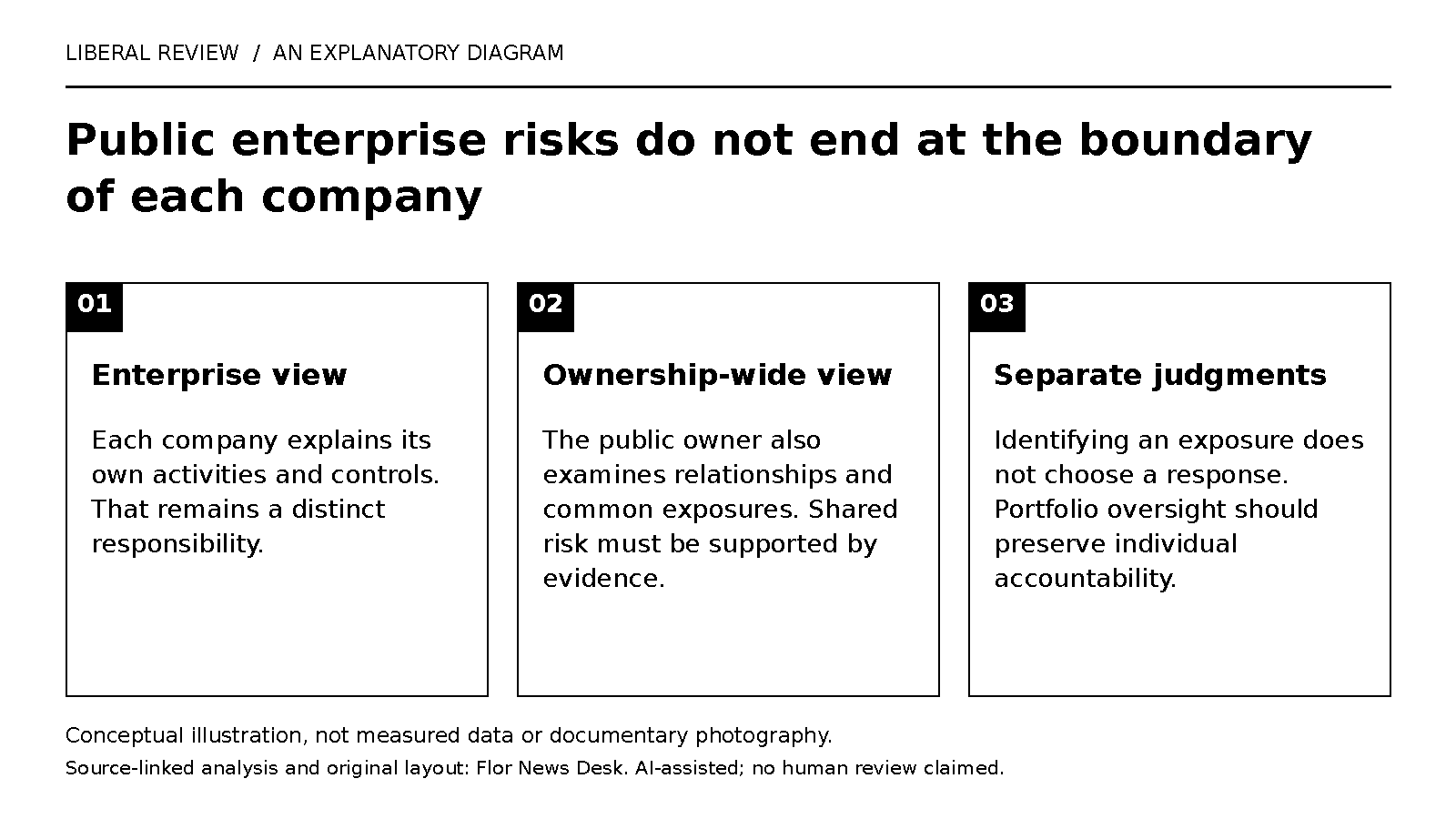
The distinction changes the question being asked. A company report is organized around that company’s obligations and operations. A portfolio assessment must also ask what separate organizations have in common, which commitments connect them, and what those relationships imply for the owner. Neither viewpoint makes the other unnecessary.
Separate accounts, connected exposure
The report’s chapter on the nature of these risks places interconnected exposures within the government ownership role. It treats portfolio oversight as complementary to enterprise-level systems rather than a substitute for them. Its discussion provides a framework and selected evidence, not a measured probability that a particular country’s companies will fail together.
Consider a purely hypothetical portfolio containing two enterprises that depend on the same external input. Each could accurately describe that dependence in its own report. Yet two separate statements would not necessarily explain the owner’s combined exposure to a disruption of that input. That additional question arises from the relationship between the companies, not from an error in either report.
The example does not establish that any real pair of enterprises shares such an exposure. It shows why collecting reports and interpreting a portfolio are different activities. A count of reporting companies cannot certify that the relationships among them have been examined.
An ownership view without blurred responsibility
This creates a difficult institutional balance. A public owner needs enough consistency to understand the portfolio, while company boards must remain responsible for their own decisions. Treating every enterprise as identical would lose relevant differences. Allowing every report to use incomparable categories would make an ownership-wide judgment difficult to explain.
The appropriate analytical aim is comparability without false equivalence. When terms differ, a portfolio account should make the distinction explicit rather than adding unlike figures. When a common exposure is only suspected, it should be described as a question requiring evidence, not promoted into a quantified finding.
There is an equally important distinction between identifying an exposure and choosing a response. Public ownership may involve objectives that cannot be reduced to a single commercial measure. A transparent assessment can explain those objectives and the obligations attached to them without treating every public commitment as a management failure. It should also avoid using a public objective to excuse an unexplained business weakness.
The OECD framework does not remove those judgments. It makes room to examine them at the appropriate level. The test of a portfolio report is therefore not how many separate company statements it reproduces, but whether it offers an intelligible account of relationships the owner needs to understand.
That account should leave individual responsibilities visible. Shared exposure is a reason to connect evidence across enterprises, not a reason to make accountability disappear into the portfolio as a whole.
Read our editorial standards or send a correction to the editorial desk.