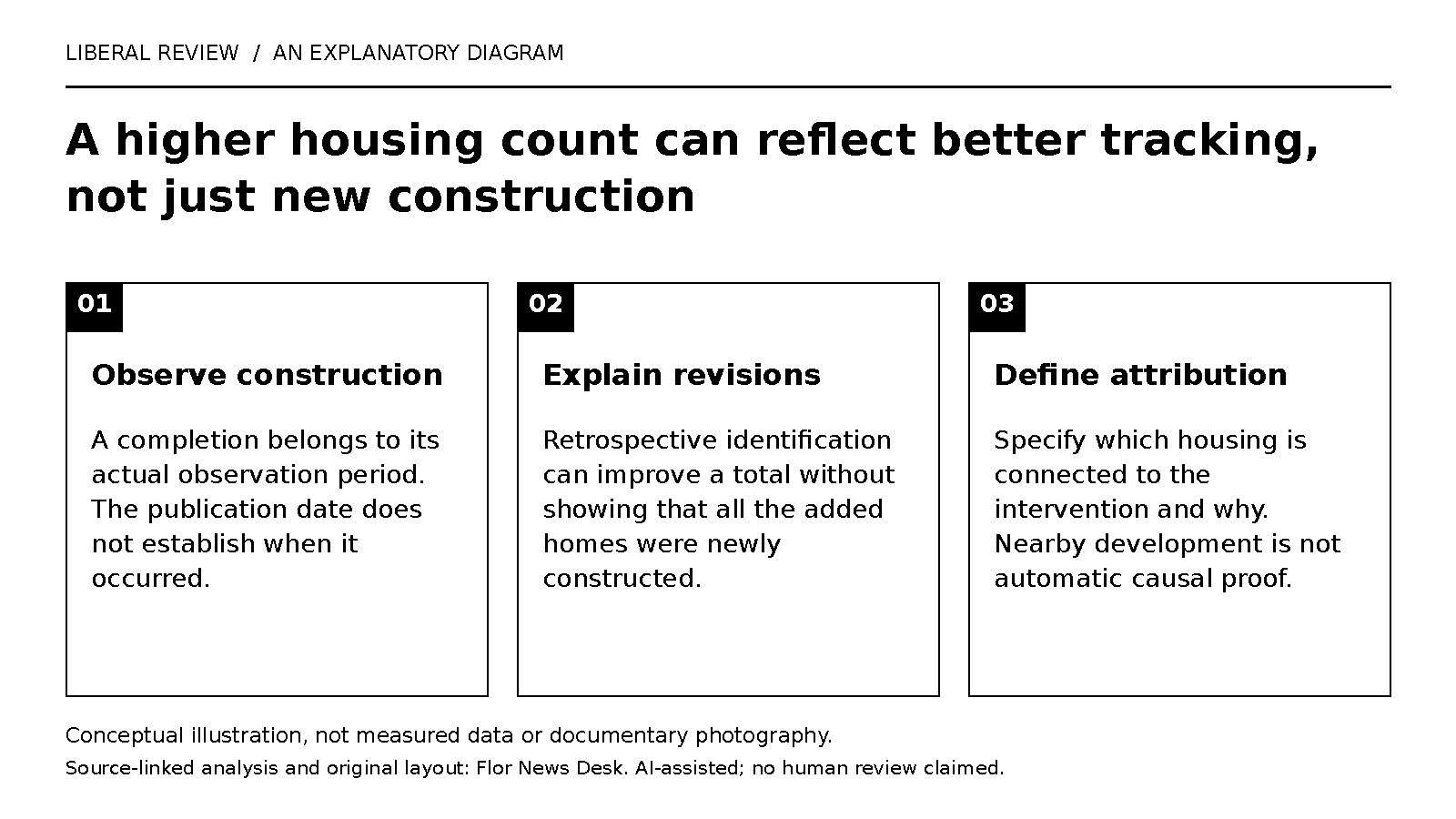
A revised housing total needs an explanation of what changed in the count as well as what changed on the ground. The Public Accounts Committee’s July 17, 2026 report on unlocking land for housing records homes identified retrospectively and questions how development is attributed to supporting infrastructure. Its scrutiny makes a basic distinction important: recognizing an existing home in a dataset is not the same event as completing a new one.
That does not make an improved count suspect. Correcting an incomplete record can be necessary. The requirement is to explain the revision rather than let a change in measurement be mistaken for a change in delivery over the same interval.
Dates describe the observation, not just the document
The background to the committee’s May 21 hearing uses a September 2025 observation of homes built on land supported by government programmes. The later report refers to December 2025 and discusses retrospective tracking. These records should not be treated as a like-for-like before-and-after construction series merely because the later document contains a larger figure. Their reference periods and the basis of identification matter.
This distinction changes what a reader can infer. A report date tells us when an account was published. An observation date identifies the period described. A revision identifies a change to what is recognized within that account. One date cannot do all three jobs.
In a hypothetical example, an authority might discover that several completed homes had been omitted from a programme return. Adding them would increase the recognized total without demonstrating that they were all constructed after the previous return. The correction would improve the record while leaving the timing of actual construction a separate matter to establish.
What does infrastructure receive credit for?
A second question concerns attribution. If an infrastructure investment serves a wider area, the programme needs an intelligible boundary for identifying the housing it claims to support. A geographical association alone cannot establish that every nearby home resulted from that investment.
The proper response is not to insist that enabling infrastructure has no housing value. It is to distinguish the supported claim. Making land available, observing completed homes on that land and demonstrating the contribution of a particular intervention are connected but different propositions. Evidence for one should not silently become evidence for all three.
A counterargument is that infrastructure can support development over a long period, making a final result unavailable when early scrutiny takes place. That is a reason to describe timing and uncertainty carefully. It is not a reason to combine a capacity estimate, an intermediate milestone and completed homes into an undifferentiated delivery figure.
The July report does not supply a current September construction count, and it should not be used to invent one. Nor does dividing an historical completion total by a broad programme ambition automatically yield a valid failure rate. That comparison would need consistent scope, dates and definitions.
A credible public account of housing investment should make those choices visible. Readers should be able to tell whether a number represents newly completed homes, improved identification of earlier completions, or an expectation about what supported land may eventually accommodate.
Read our editorial standards or send a correction to the editorial desk.