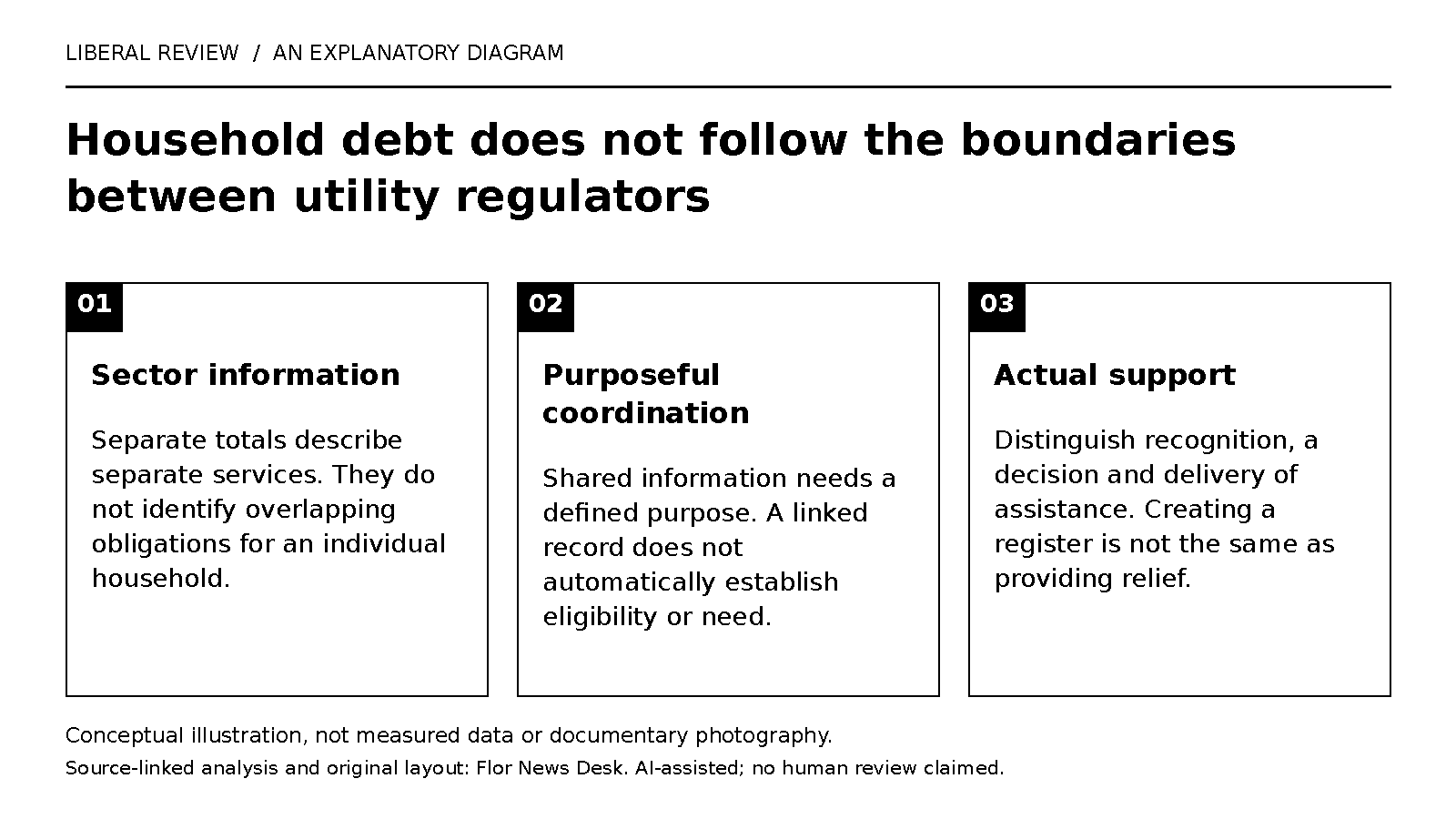
Energy, water and broadband are regulated separately, but an individual’s obligations need not fit inside one sector. The Public Accounts Committee’s September 11, 2026 report questions the absence of a comprehensive view of a person’s debt across the three services. That is a criticism of cross-sector visibility, not a claim that regulators possess no information about their own sectors.
The distinction matters for interpreting aggregate figures. A sector total can describe the amount owed within that sector. It cannot, on its own, identify which people also have obligations elsewhere or establish the circumstances of a particular household. Adding totals would not supply the missing relationship between the records.
A household is not a sector average
The committee’s announcement of the findings argues for better coordination and less repetition of personal information when consumers seek support. It presents changes to shared information and assistance as recommendations. The announcement does not establish that a universal register or a new entitlement has already been implemented. Its criticism is an institutional assessment, not an individual debt assessment.
A hypothetical example shows the analytical gap. The same person could appear in records held by more than one provider. Three accurate sector summaries would still not establish that overlap unless the relevant relationship between the records was known. Conversely, identifying the same person in several records would not automatically establish financial vulnerability, eligibility for assistance or an appropriate response.
Those are separate judgments. A combined view may supply relevant information, but information is not itself relief. A credible reform should therefore explain what a shared record is for and what decision it is intended to support, rather than presenting the creation of a database as the completed policy outcome.
Coordination needs boundaries of its own
There is a serious counterargument to indiscriminate sharing. The purpose of understanding overlapping needs does not establish that every organization needs every detail about a person. An accountable arrangement would have to justify its information requirements and explain responsibility for accuracy, access and correction. Those are design questions here, not a statement of particular legal duties or advice about an individual’s rights.
The distinction between kinds of support also needs to remain visible. Assistance with communication, safety or access is not interchangeable with financial assistance. A record that someone needs one form of support should not silently be interpreted as proof of eligibility for another. Treating all vulnerability as one category would obscure the very circumstances coordination is meant to understand.
A policy can be assessed at several stages without confusing them: whether relevant needs are recognized, whether the appropriate decision-maker receives usable information, and whether the promised assistance reaches an eligible person. Evidence that the first stage works cannot certify the last.
The September inquiry makes the case for examining the household across organizational boundaries. The corresponding obligation is to explain what happens after that examination. Otherwise, public institutions would have a more connected account of difficulty without an equally clear account of how they intend to respond.
Read our editorial standards or send a correction to the editorial desk.