British Steel’s continued operation and its long-term future deserve different tests. In its September 18, 2026 report, the Public Accounts Committee credits the government’s April 2025 emergency intervention with preventing the closure of the blast furnaces. It nevertheless questions the plan for a financially sustainable, lower-carbon business. These judgments are compatible: avoiding an immediate loss of capability does not establish which future production choices should receive public support.
The argument for intervention should therefore be stated in its strongest form. Preserving a capability can keep a future choice available. That does not require pretending that the preserved business already has a settled investment programme. Conversely, uncertainty over that programme is not, by itself, proof that the earlier emergency decision lacked a public purpose.
What continuing support establishes
The committee’s accompanying announcement distinguishes working-capital funding from the unresolved cost of transformation. It also records trade unions’ concern that a transition should protect employment and skills. Those are the committee’s account of the evidence and the unions’ stated priorities, not a guarantee about future jobs or the final cost of public ownership.
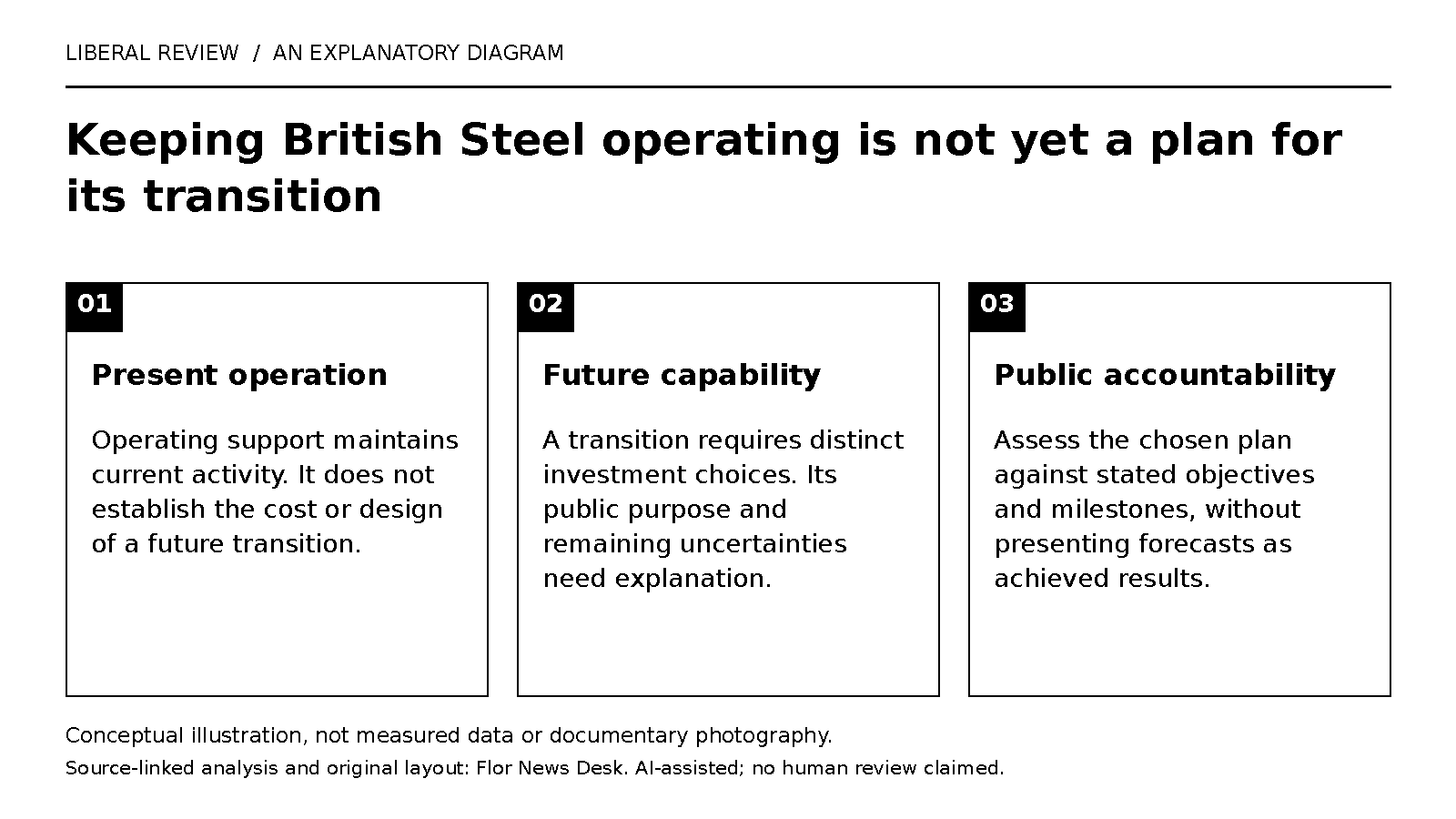
This distinction matters when judging a funding announcement. Paying for continued operation answers whether the business can keep functioning over the period financed. It cannot also answer which facilities should be changed, how those changes would be paid for, or what would make the resulting operation sustainable. Those are additional propositions requiring their own explanation.
Consider a hypothetical public owner that authorizes both operating support and a later equipment investment. Even if both payments serve the same industrial objective, they purchase different things. The first maintains present activity; the second seeks to alter future capability. Treating the first payment as evidence that the second decision has already been resolved would conceal the choice rather than defend it.
A public purpose that can be examined
A defensible transition plan would connect the chosen industrial objective to decisions that can be checked. What capability is being retained? Which proposed changes are necessary for that objective? What remains uncertain, and who is responsible for resolving it? These are questions for assessing the plan, not claims that a particular technology or ownership model must win.
There is a serious counterargument to demanding premature precision. A plan can acknowledge unresolved negotiations and technical choices without supplying a misleading final price. Accountability need not mean converting every uncertainty into a firm promise. It does mean separating a considered range of choices from an unexplained continuation of support.
The September report does not establish the outcome of decisions made after its publication. Nor can its spending observations be extended into a reliable lifetime cost simply by multiplying a daily figure. The useful test is narrower: whether the government explains how continuing operation relates to an intended transition, and what evidence would show progress toward it.
Protecting steelmaking and scrutinizing its future are not rival positions. Public support can be defended on its stated purpose while the route, costs and consequences remain open to rigorous examination.
Read our editorial standards or send a correction to the editorial desk.