

On 10 September 2026, the World Bank Group announced a 29-month debarment with conditional release for African Consulting Surveyors and its managing director, Willem Jan Timmerman, over conduct connected to the Mozambique Land Administration Project, Terra Segura. The useful question is not whether this counts as punishment. It plainly does. The harder question is whether one sanction can both protect procurement and demonstrate reform. The public record now opened shows the first more clearly than the second. The Bank said the settlement included admissions of culpability and attached conditions for eventual release, but those are different institutional claims with different evidentiary weight. World Bank Group press release
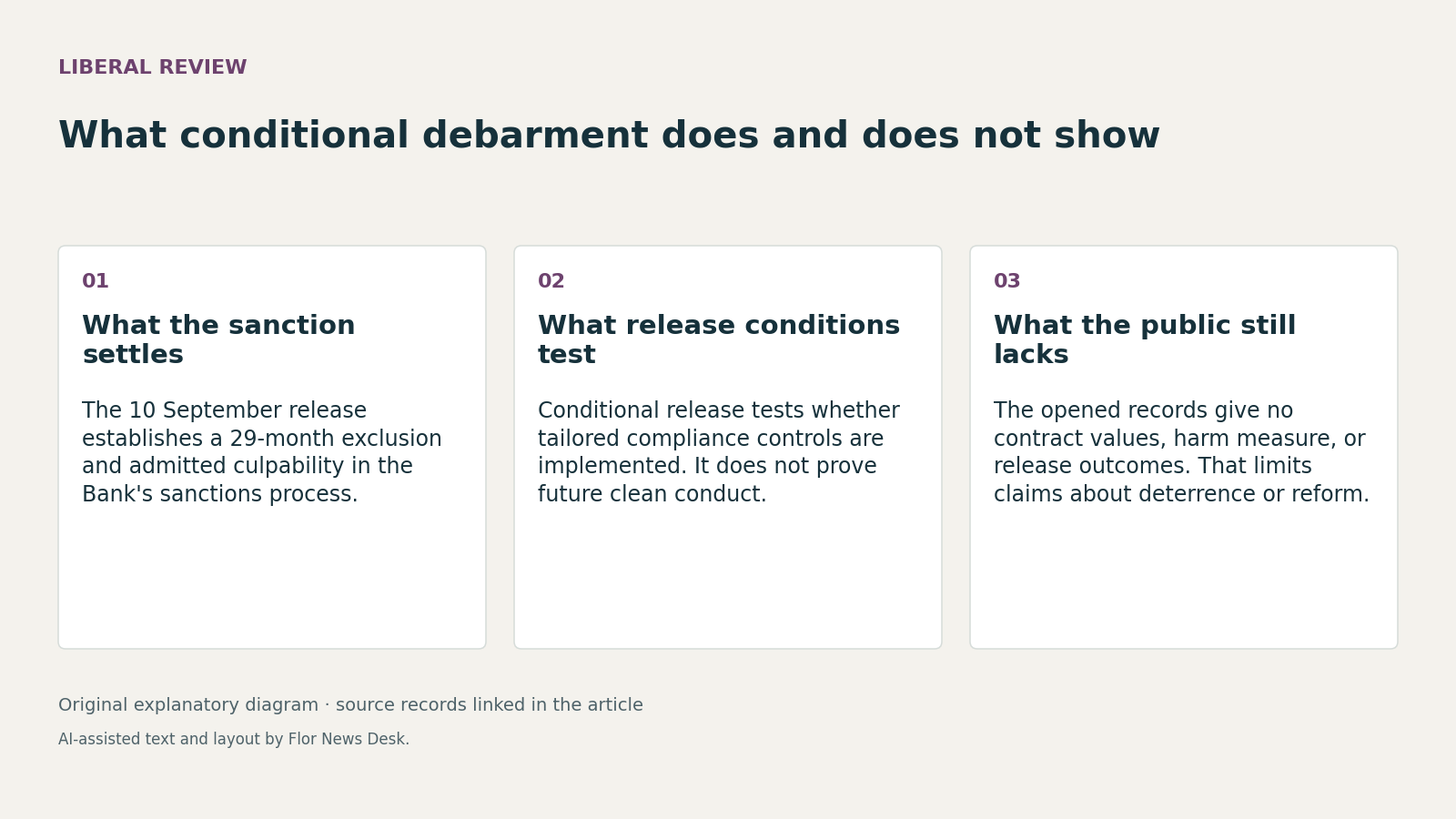
What debarment establishes is exclusion. The World Bank Group's sanctions page says debarred firms and individuals are ineligible for World Bank Group-financed contracts, and that debarment with conditional release is the system's baseline sanction. Sanctions & Compliance That is a concrete safeguard for future awards. But exclusion answers a narrower question than many readers will ask. The 10 September announcement does not provide contract values, payment amounts, or any measure of project harm, and it does not show that every Terra Segura contract involving ACS was compromised. World Bank Group press release
The Bank did describe the conduct it said justified sanctions. According to the release, Timmerman signed a certification stating that ACS had not paid, and would not pay, commissions, gratuities, or fees tied to procurement or contract execution, while ACS in fact paid undisclosed business development consultants. The same release says ACS obtained confidential procurement information from third-party facilitators and used it to influence technical specifications and gain an improper advantage. World Bank Group press release Those admissions matter inside the Bank's sanctions process. They do not, on this record, establish a criminal conviction, publish the underlying evidence, or identify every other participant.
Conditional release serves another purpose entirely. The sanctions page says sanctioned parties with release conditions enter the Integrity Compliance Office portfolio, and that release depends on controls tailored to the sanctioned party's risks, consistent with the Integrity Compliance Guidelines, and supported by a demonstrated record of implementation. Sanctions & Compliance That is more than a symbolic apology. It is an administrative demand for redesigned controls. Still, it is not public proof that rehabilitation is complete. The 10 September release said the reduced debarment period reflected cooperation, voluntary restraint during settlement negotiations, and voluntary corrective actions. Those are the Bank's stated reasons for leniency, not evidence that the compliance system has already worked. World Bank Group press release
A serious counterargument is that this dual design is the point. The annual-reports index describes a sanctions architecture spanning prevention, investigation, adjudication, enforcement, and reform, while the sanctions page presents conditional release as a standard feature rather than an exception. Annual Reports Sanctions & Compliance On that view, exclusion without a path back would protect procurement but give up on institutional change inside firms that may later seek Bank-financed work. That is a plausible design argument. What the current public materials do not show is whether the design succeeds in practice.
To judge that, outsiders would need more than a sanction length and a press announcement. They would need public materials that let them separate deterrence from remediation: fuller case reasoning or settlement terms, later disclosure on whether release conditions were satisfied, and aggregate reporting on how often conditional release leads to verified compliance rather than simple passage of time. The opened records here do not supply that evidence. The press release announces a sanction, the sanctions page explains the mechanism, and the annual-reports index sketches the institutional ambition. World Bank Group press release Sanctions & Compliance Annual Reports Until more is public, conditional debarment can be shown to punish by exclusion, while reform remains a supervised prospect, not a demonstrated outcome.
Read our editorial standards or send a correction to the editorial desk.