
A fiscal watchdog cannot be assessed only by the number of responsibilities attached to its name. The OECD’s September 11, 2026 review of the Irish Fiscal Advisory Council praises its contribution while identifying constraints on detailed spending information and staffing autonomy. The combination points to a practical test of institutional independence: whether the Council has the information and capacity needed to perform the work expected of it.
That is different from asking whether its judgments agree with the government’s. Independent scrutiny has a purpose precisely because an assessment may challenge the assumptions behind a preferred policy. Agreement is not proof of independence, and disagreement is not proof that an institution has been given adequate resources.
Good headline figures do not settle every question
The review’s chapter on the domestic and international context considers Ireland’s strong fiscal headline position alongside its exposure to concentrated multinational-related tax revenues. It explains why the composition of those revenues and the choice of economic benchmark matter to scrutiny. This is the OECD’s analysis of the Irish case, not a prediction that tax receipts will collapse or that a particular budget decision must follow.
The implication is analytical rather than prescriptive. A favourable aggregate can answer one question while leaving another open. A fiscal balance describes a relationship between revenues and spending over a specified period. It cannot, by itself, establish how dependable every underlying revenue source will be under different conditions.
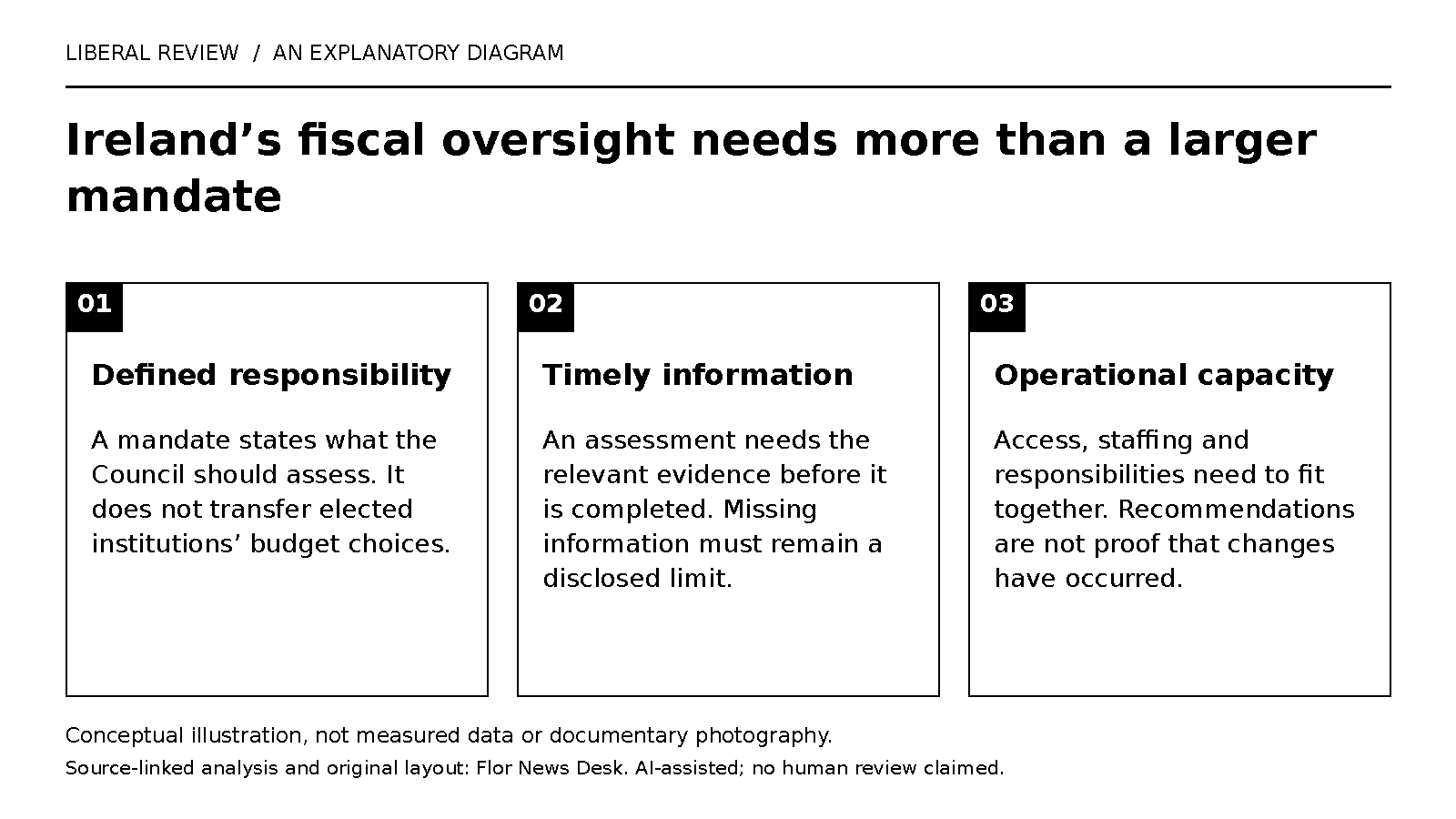
Nor does identifying that uncertainty give a watchdog the authority to choose the budget. Evaluating assumptions, explaining risks and deciding how public money should be allocated are distinct functions. The argument for better oversight is not an argument that elected institutions should surrender their decisions to analysts.
Responsibility needs usable information
Consider a hypothetical assessment with a fixed publication date. If a necessary spending breakdown arrives only after that date, the existence of a formal assessment duty does not supply the missing evidence. The assessor can disclose the limitation, but it cannot honestly turn unavailable information into a completed examination.
Access and staffing are separate concerns as well. Detailed data without the capacity to examine them do not constitute a finished analysis. Additional staff cannot establish figures that remain unavailable. A serious institutional design must connect the duty, the information and the capacity instead of expanding one element in isolation.
A counterargument deserves weight: public institutions must operate within approved budgets and accountable information arrangements. Operational independence should not mean unlimited spending or unrestricted publication of sensitive material. The relevant distinction is between legitimate constraints and conditions that leave a stated responsibility impossible to discharge as promised.
The September review does not establish whether its recommendations have subsequently been implemented. Its value is in identifying the institutional questions against which a response could be examined. What information is needed, when must it arrive, and who resolves an access problem? What discretion is necessary to organize the work within an approved budget?
A larger mandate is meaningful only when those questions have credible answers. Otherwise, the public receives an expanded description of oversight without equivalent assurance about what can actually be assessed.
Read our editorial standards or send a correction to the editorial desk.