The Government Shared Services strategy presents a question that cannot be settled by a dashboard: who can secure the commitments on which shared delivery depends? In its July 15, 2026 report, the Public Accounts Committee questions the Cabinet Office’s ability to obtain consistent departmental participation and reporting. Its criticism distinguishes the collection of delivery information from the authority to make a collective strategy work.
This is an analysis of that July record, not a claim that a fresh delay has occurred in September. The report’s warnings concern the strategy as examined by the committee. They do not establish that it has subsequently failed or that every department has rejected cooperation.
Visibility is not agreement
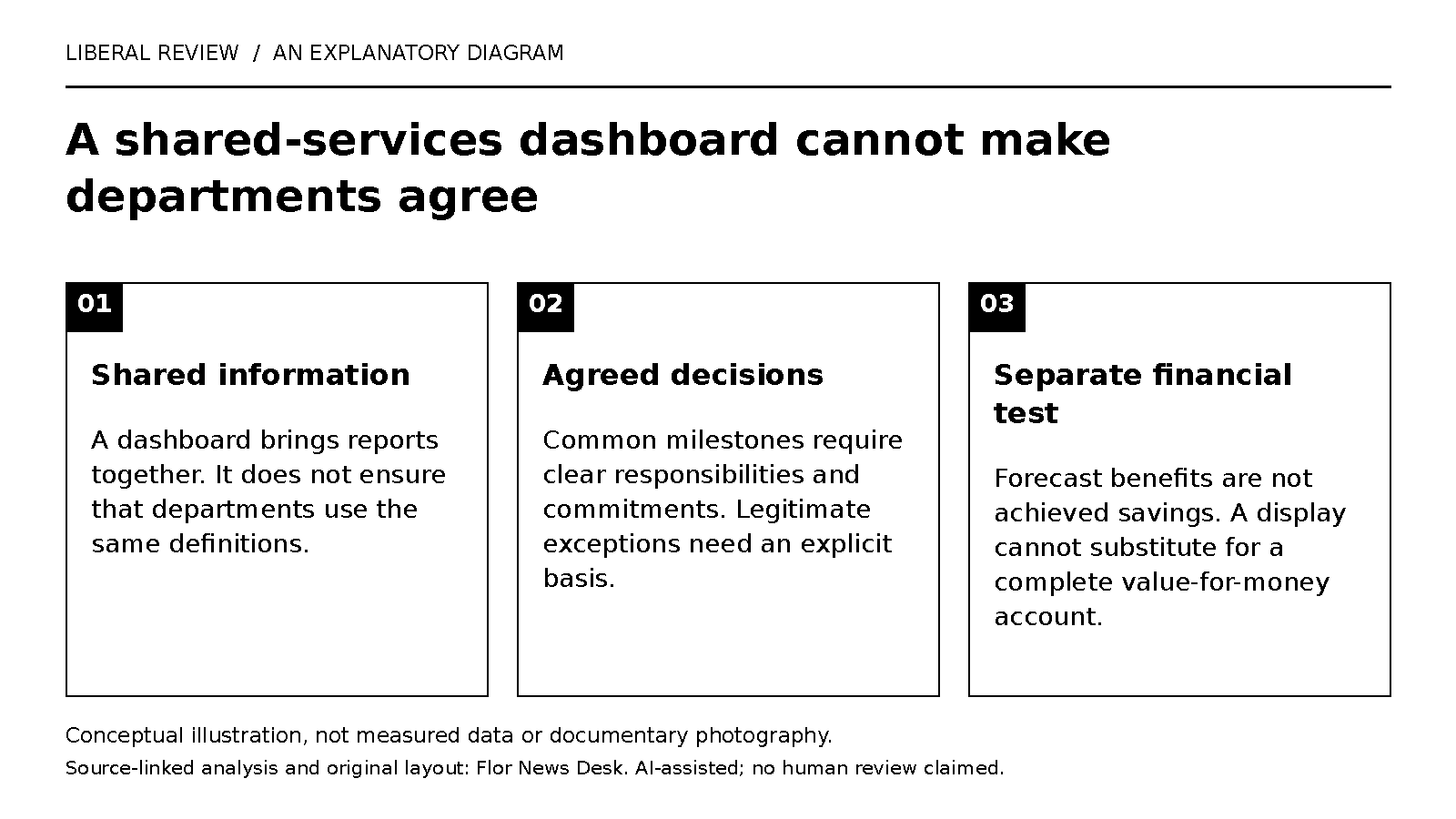
The committee’s same-day announcement describes the Cabinet Office’s dashboard and the absence of formal commitments from some departments. It also distinguishes the programme’s forecast benefits from an account that includes costs. Those are attributed findings about the strategy’s governance and business case, not achieved savings or an independent evaluation of a later implementation.
A dashboard can provide a common place to display information. It cannot logically create the agreement that makes the information comparable. If organizations interpret a milestone differently, showing their entries on one screen does not establish that the same thing has been completed in each case.
Consider a hypothetical shared programme in which one department reports that it is ready when a technical component is available, while another uses readiness to mean that staff and data are prepared as well. Both entries could be sincere. A combined display would still need an agreed definition before it could support a reliable comparison.
The problem would not necessarily be solved by adding another reporting field. It would require a decision about the standard, responsibility for applying it and a way to resolve disagreement. That is why the governance question should come before confidence in the display.
Common standards and legitimate differences
There is a reasonable case against imposing identical processes regardless of departmental purpose. Shared infrastructure need not eliminate every local requirement. But legitimate differences should be identified and justified within the strategy, rather than left to emerge as incompatible assumptions about participation.
The analytical test is whether the arrangement distinguishes decisions that must be common from decisions that can remain local. Who approves an exception? Who bears the consequences for shared delivery? What must a department commit to before the collective programme relies on its participation? These questions do not imply that central authority should be unlimited; they ask that authority and responsibility be intelligible.
The financial argument requires a parallel discipline. A forecast benefit is not an achieved result, and a benefit estimate alone is not a net value-for-money assessment. Changing the quality of a dashboard would not settle either issue unless the underlying definitions and evidence also changed.
The July scrutiny is useful because it links these matters without conflating them. A programme needs credible information about progress, but it also needs an agreed basis for making decisions together. Visibility can support accountability only when someone is answerable for what the display is meant to show.
Read our editorial standards or send a correction to the editorial desk.