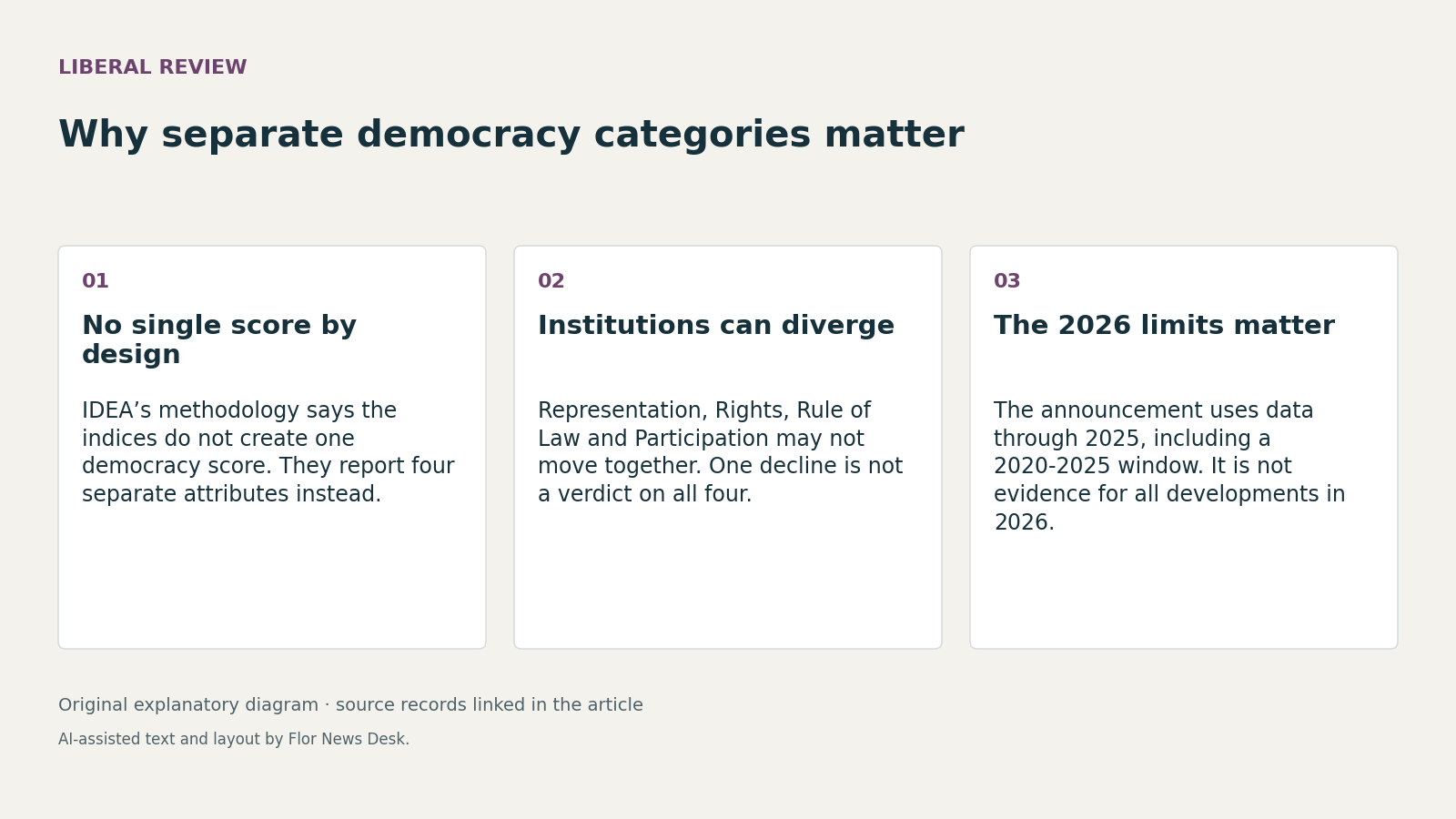
International IDEA’s September 15 report announcement matters partly because of what it declines to offer: not a single democracy label, but four separate categories of democratic performance, with findings presented across Representation, Rule of Law, Rights and Participation IDEA announcement. That is not a cosmetic design choice. In the accompanying Version 10 framework, International IDEA says its indices do not provide one overall democracy index and instead organize measurement through those four attributes methodology. The analytical gain is simple: the reader can still ask which institution is changing.
That question would be harder to preserve if everything were collapsed into one score. International IDEA’s methodological premise is that democratic principles can be realized through different institutional arrangements, which is why it reports distinct measures rather than merging all attributes into a single figure methodology. Once that premise is accepted, divergence is not noise but part of the subject. The September 15 announcement, for example, describes Representation as the strongest-performing category globally, while also reporting 17 declines and 4 advances in that same category between 2020 and 2025; it separately says Rule of Law had 71 of 173 assessed countries in the low-performance band and 29 downturns IDEA announcement. A single label would flatten those differences.
A hypothetical case shows why that flattening matters. One country might sustain competitive representation while its courts or legal constraints weaken; another might protect formal rights better than it mobilizes participation. Calling both simply stronger or weaker democracies would answer a different question from the one institutions actually pose. The virtue of separated categories is not that they eliminate argument, but that they force it onto a more precise terrain: elections are not the same thing as civil liberties, and neither is identical to judicial restraint or civic participation. The framework keeps that distinction visible methodology.
The methodology also gives another reason to resist the temptation of one grand number. International IDEA says Version 10 is built from 155 indicators drawn from expert surveys, standards-based coding, observational data and composite measures, and that yearly scores for almost all indices include uncertainty estimates, with Electoral Participation, Inclusive Suffrage, Direct Democracy and Local Democracy named as exceptions methodology. On its face, that is already a heterogeneous evidentiary system. Analysis: compressing such material into a single headline score would not merely simplify it; it would obscure which components moved and how confidently they were measured.
This is also why the report’s broadest findings should be read carefully rather than rhetorically. International IDEA says 57 percent of countries declined in at least one key indicator between 2020 and 2025, and that 2025 was the 11th consecutive year in which more countries showed net decline than improvement in its records beginning in 1975 IDEA announcement. Those are the institution’s aggregate assessments from data ending in 2025, not evidence about all developments during 2026. Nor does a decline in one indicator establish that a country is undemocratic, or that every democratic institution moved in the same direction.
The source record itself points toward modesty. Both documents come from International IDEA, so the announcement is best read alongside the methodology rather than as an independent validation of it. And the retrieved materials leave at least one unresolved technical point: the announcement’s category summaries use 173 assessed countries, while the methodology says the indices produce data for 174 countries IDEA announcement methodology. That gap does not void the exercise. It does clarify its proper use. The report is most illuminating when treated as a map of institutional divergence, not a final verdict disguised as arithmetic.
Read our editorial standards or send a correction to the editorial desk.