

A procurement system can display a warning without establishing that anyone has committed misconduct. The institutional question is what happens next, and who is responsible for a reasoned response. The OECD’s June 26, 2026 roundtable on competition and corruption in public procurement addresses coordination among procurement, competition and anti-corruption bodies. Its agenda treats their work as connected without making their responsibilities identical.
This is a dated examination of the 2026 policy discussion, not a report of a new September enforcement action. No particular supplier is accused here. The distinction at issue is between information that warrants attention and evidence sufficient to support a finding through an appropriate procedure.
Data are an input to responsibility
The procurement chapter of the OECD’s Anti-Corruption and Integrity Outlook 2026 discusses risk-based approaches and the potential role of better data governance and interoperability. It does not establish that introducing a digital tool automatically detects corruption or proves a breach. Its assessment of institutional safeguards is a different kind of evidence from an investigation of a named contract.
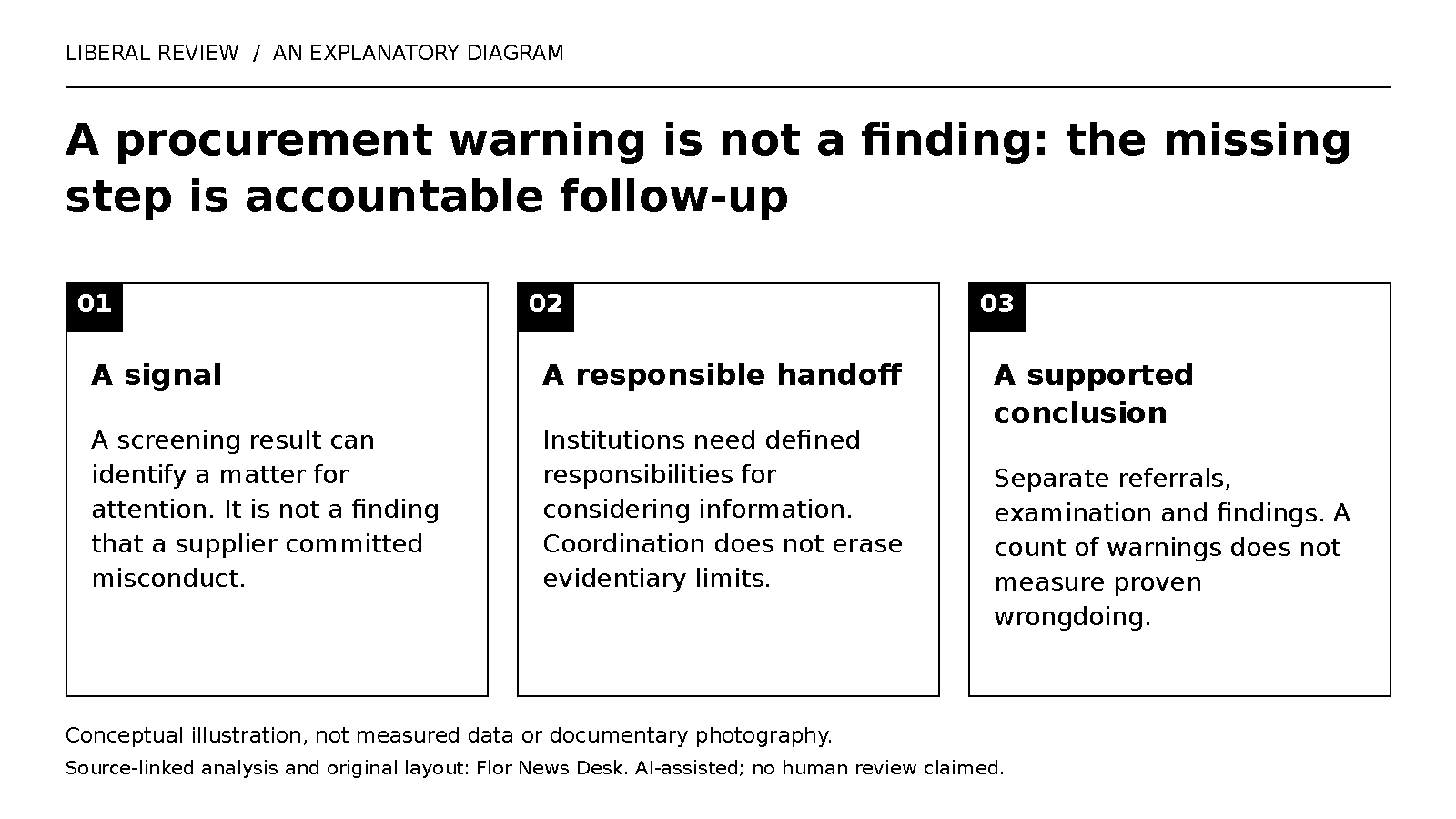
The distinction can be made without describing a technical detection technique. In a hypothetical process, a screening system might refer a transaction for examination. That referral would show that a criterion had been met. It would not establish the explanation for the transaction, the responsibility of the parties, or whether the relevant standard for a finding had been satisfied.
An accountable process should therefore distinguish the creation of a referral, the decision to examine it and the conclusion reached. Combining those stages in a single success count would obscure what the system had actually accomplished. A high number of referrals is not, by itself, evidence of either widespread misconduct or effective enforcement.
Coordination without a presumption of guilt
The argument for coordination is not an argument for unrestricted circulation of allegations. Institutions may have different powers and evidentiary responsibilities. An arrangement that shares information should explain the purpose of the exchange and preserve the distinction between a suspicion and a supported conclusion.
There is a serious counterargument to making every warning trigger a full investigation: attention and investigative capacity are not unlimited. That does not justify ignoring the handoff. It makes the criteria for follow-up, the responsibility for decisions and the treatment of unresolved information important elements of the design.
Similarly, a public commitment to transparency should not be reduced to publishing more data. Publication can make information available for scrutiny; it cannot establish that the institution with the relevant responsibility has assessed it. The next step requires an accountable decision, not merely another display of the same information.
The OECD records support examining technology and institutional arrangements together. They do not supply a universal procedure or a measured success rate for every tool. The useful public test is whether a proposed system explains what its signals mean, who considers them and how any resulting finding is justified.
That preserves both sides of integrity: taking plausible concerns seriously and refusing to present an untested warning as proof.
Read our editorial standards or send a correction to the editorial desk.