
International IDEA’s latest Global State of Democracy report is most useful when read as a boundary marker. It can tell policymakers that certain democratic conditions worsened or improved across a defined period; it cannot, by itself, prove why they changed, whether conflict caused the shift, or whether a later reform agenda will succeed. That distinction matters because International IDEA also put the report into an overtly policy-facing setting, with a Brussels launch scheduled for 16 September 2026 alongside officials and analysts from European and transatlantic institutions, according to the event page. An agenda is evidence of intended audience, not of policy uptake.
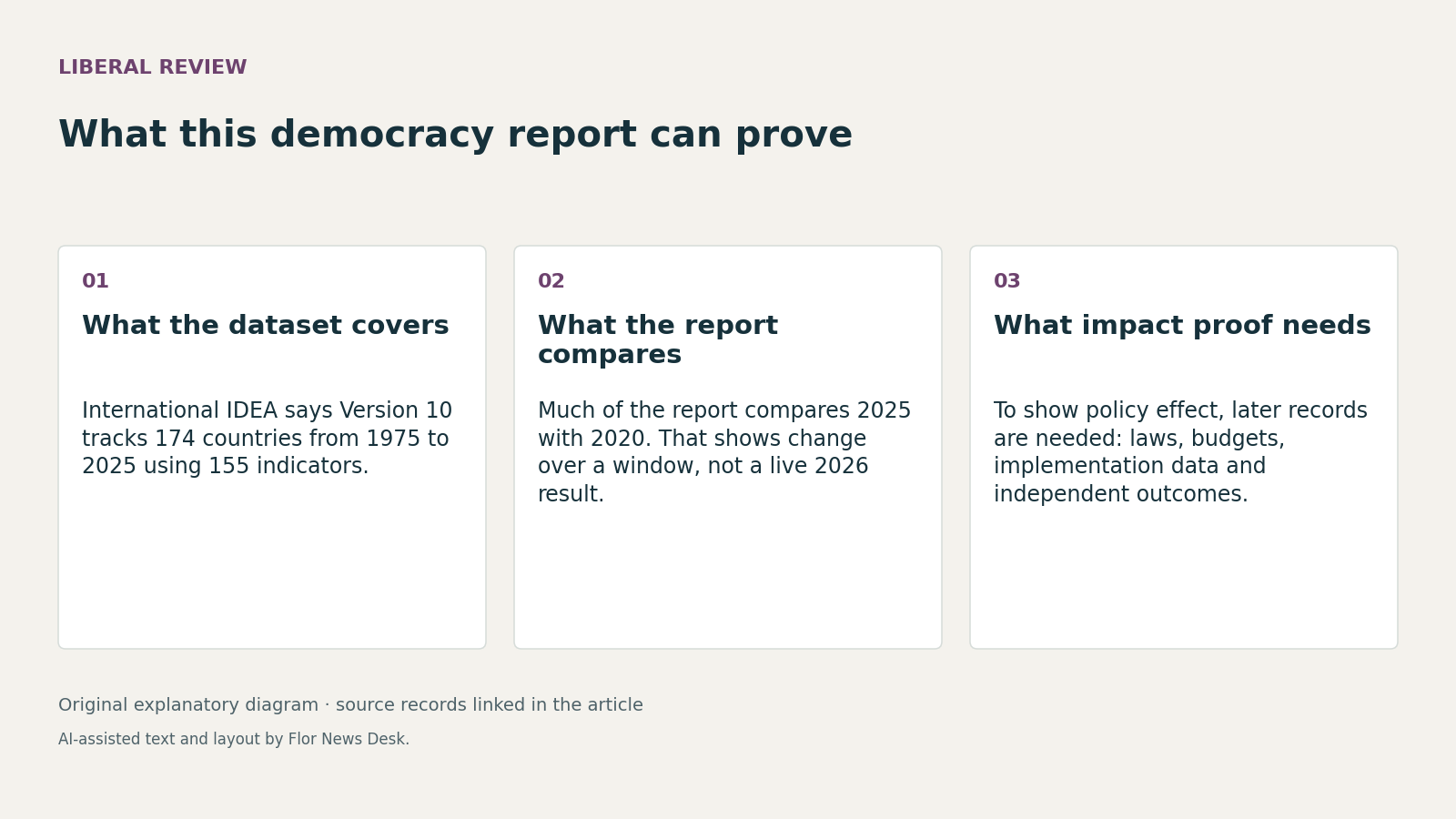
What the report does establish is scale and timeframe. International IDEA says the 2026 assessment relies mainly on Version 10 of the Global State of Democracy Indices, with coverage for 174 countries from 1975 to 2025, using 155 indicators from 23 data sources and 1,951,184 data points, as described on the report page. The same page says much of the headline comparison is between 2025 and 2020. That is a strong basis for historical benchmarking. It is not a live readout of political conditions in late 2026.
Within that window, International IDEA reports a mixed but clearly troubling picture. On its account, 81 percent of country-factor cases showed no change, while 98 countries declined in at least one factor and 55 improved in at least one factor between 2025 and 2020, according to the same report page. It also identifies Rule of Law as the weakest category in 2025, with 71 countries in the low-performing band and 29 showing category-level downturns. Those are concrete comparative claims. They support an argument about the breadth of democratic strain, not a claim that every country is on the same trajectory or that decline is uniform.
The conflict argument is even more important to read carefully. International IDEA’s conflict section cites Uppsala Conflict Data Program figures of 65 violent conflicts and 8 interstate conflicts in 2025, and the report describes the democracy-conflict relationship as complex rather than straightforward, again on the report page. That phrasing is a methodological restraint, not a rhetorical hedge. If democracy scores and conflict measures move together, the result may justify concern and further investigation. It does not by itself identify a causal chain, a trigger, or a sequence of institutional failures.
The supporting technical pages reinforce that caution. International IDEA’s Version 10 codebook page and Version 10 methodology page say the indices were revised and updated for 2026 and combine expert surveys, standards-based coding, observational data and other composite measures. That makes the project broad and serious. But the fetched records available here are overview pages, not the full technical texts, so they do not let a reader inspect every variable definition, coding rule or uncertainty note from within this source set. The prudent reading is that the indices are a synthesized assessment, not a transparent substitute for underlying country records.
So what can policymakers properly do with this material? Use it to ask sharper questions, compare countries across a common framework, and test whether a claimed crisis is visible over time. What it cannot prove is implementation or impact. As analysis, moving from diagnosis to demonstrated policy effect would require later records the current source set does not provide: enacted laws, budget appropriations, implementation timetables, programme monitoring, and independent outcome measures tied to specific reforms. Until those records are assembled, International IDEA’s 2026 report is best treated as a rigorous warning system, not as the final word on causes or cures.
Read our editorial standards or send a correction to the editorial desk.