
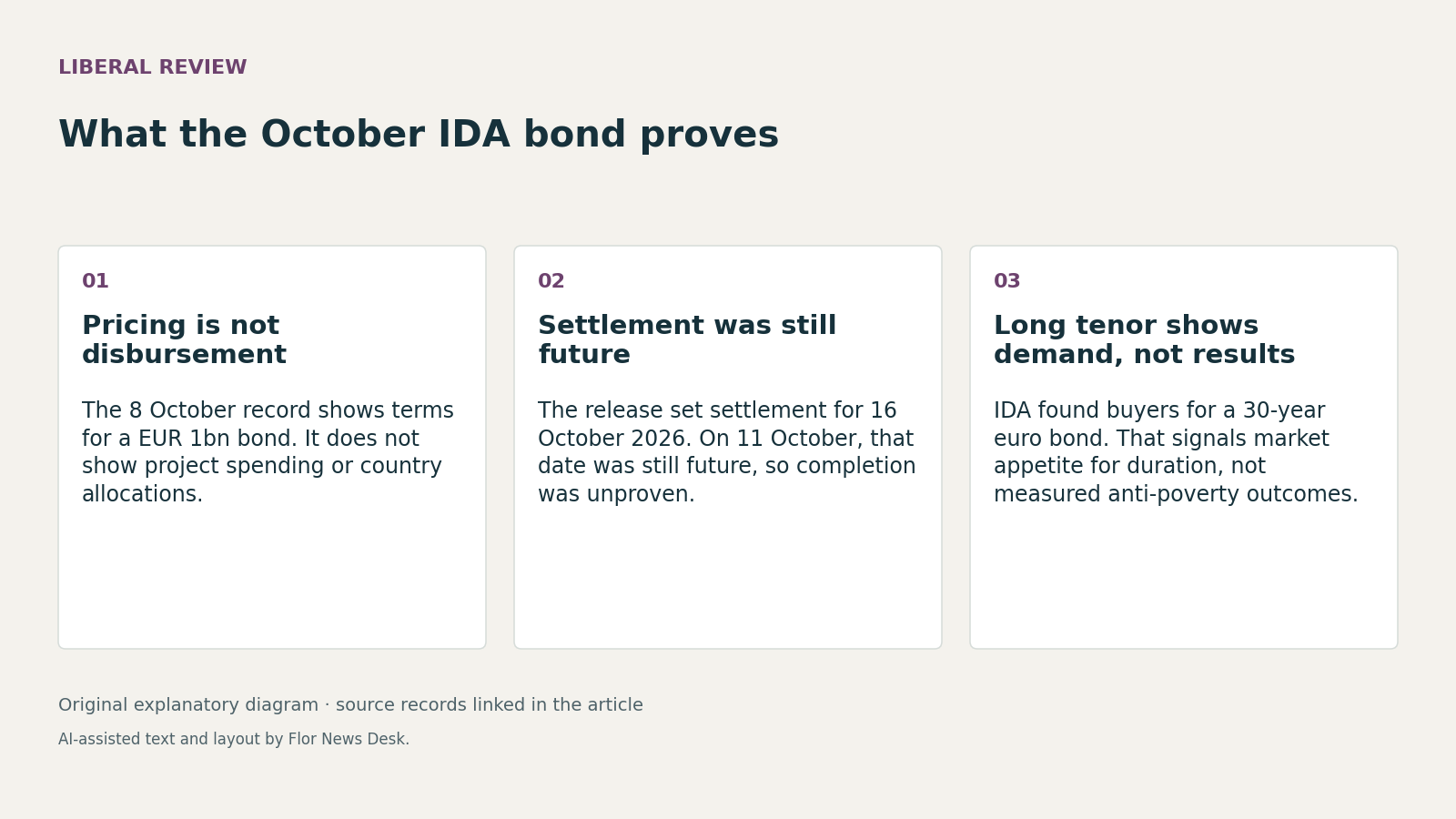
IDA’s EUR 1 billion bond on 8 October 2026 should be read first as a funding-market event, not as proof that new money has already reached low-income countries. The World Bank said the International Development Association priced a 30-year Sustainable Development Bond due on 16 October 2056, with settlement scheduled for 16 October 2026. As of the current date, 11 October 2026, that settlement date was still in the future, so the public record here shows pricing terms and stated demand, not completed cash receipt or project delivery. World Bank press release, 8 October 2026
What the 8 October record does establish is unusually specific. The World Bank said the bond carried a 4.300% annual coupon, a 99.353% issue price, a 4.339% annual yield, and a spread of 42.8 basis points over the reference Bund. It also identified BNP Paribas, Deutsche Bank and DZ BANK AG as lead managers, gave the ISIN as XS3538132773, named Euroclear and Clearstream as clearing systems, and said the bond would be listed on the Luxembourg Stock Exchange. The same release described the sale as IDA’s first euro issuance of the fiscal year, its first EUR 30-year bond in global benchmark format, and its largest 30-year issuance, with 28 orders. Those are meaningful financing facts, but they are still financing facts. World Bank press release, 8 October 2026
The key analytical distinction is between raising funds and allocating them. A separate IDA bond announcement on 15 September 2026 said, in general terms for that programme, that net proceeds from the bonds are not committed or earmarked for any particular projects or programs, and that bond payments are not funded by any project or program. The source brief contains no later document contradicting that logic for the 8 October euro bond. So the evidence supports a narrower claim: bond issuance can expand IDA’s institutional funding capacity, but it does not tell readers which countries, sectors or projects will benefit, on what timetable, or in what amount. World Bank press release, 15 September 2026
The longer maturity matters, but not in the simple way press releases can imply. The World Bank’s own bond-issues table shows IDA has used several points on the curve: a EUR 2 billion 15-year bond settled on 20 May 2026, and a EUR 0.6 billion 30-year bond settled on 3 November 2023. The 15 September 2026 dollar deal was larger at USD 3 billion, but much shorter at five years and reportedly drew 125 orders totaling almost USD 8 billion. The 8 October sale therefore looks less like a sudden transformation than like an extension of IDA’s market access into a longer euro tenor and larger 30-year size. That may matter for balance-sheet flexibility, but these records do not show whether it will change lending volumes or terms for borrowers. IDA Bond Issues World Bank press release, 15 September 2026
There is also a practical warning in the documentary trail. The bond-issues table retrieved on 11 October 2026 did not yet show the new 8 October euro bond. That does not disprove the sale; it does show that public reference pages can lag behind announcements. Readers should therefore separate four stages that sources often blur together: pricing, settlement, later funding allocation, and eventual disbursement or measured outcome. This source set only covers the first stage clearly. IDA Bond Issues World Bank press release, 8 October 2026
So what did the bond really buy? On the evidence available, it bought IDA the chance to lock in long-dated euro funding if settlement occurred on 16 October 2026 as planned, and it gave the World Bank a fresh data point on investor willingness to hold IDA debt to 2056. That is not trivial. But neither is it the same thing as a new school, clinic or cash transfer. Until later records show approvals, commitments or disbursements, the development meaning of the bond remains prospective rather than demonstrated. World Bank press release, 8 October 2026
Read our editorial standards or send a correction to the editorial desk.