
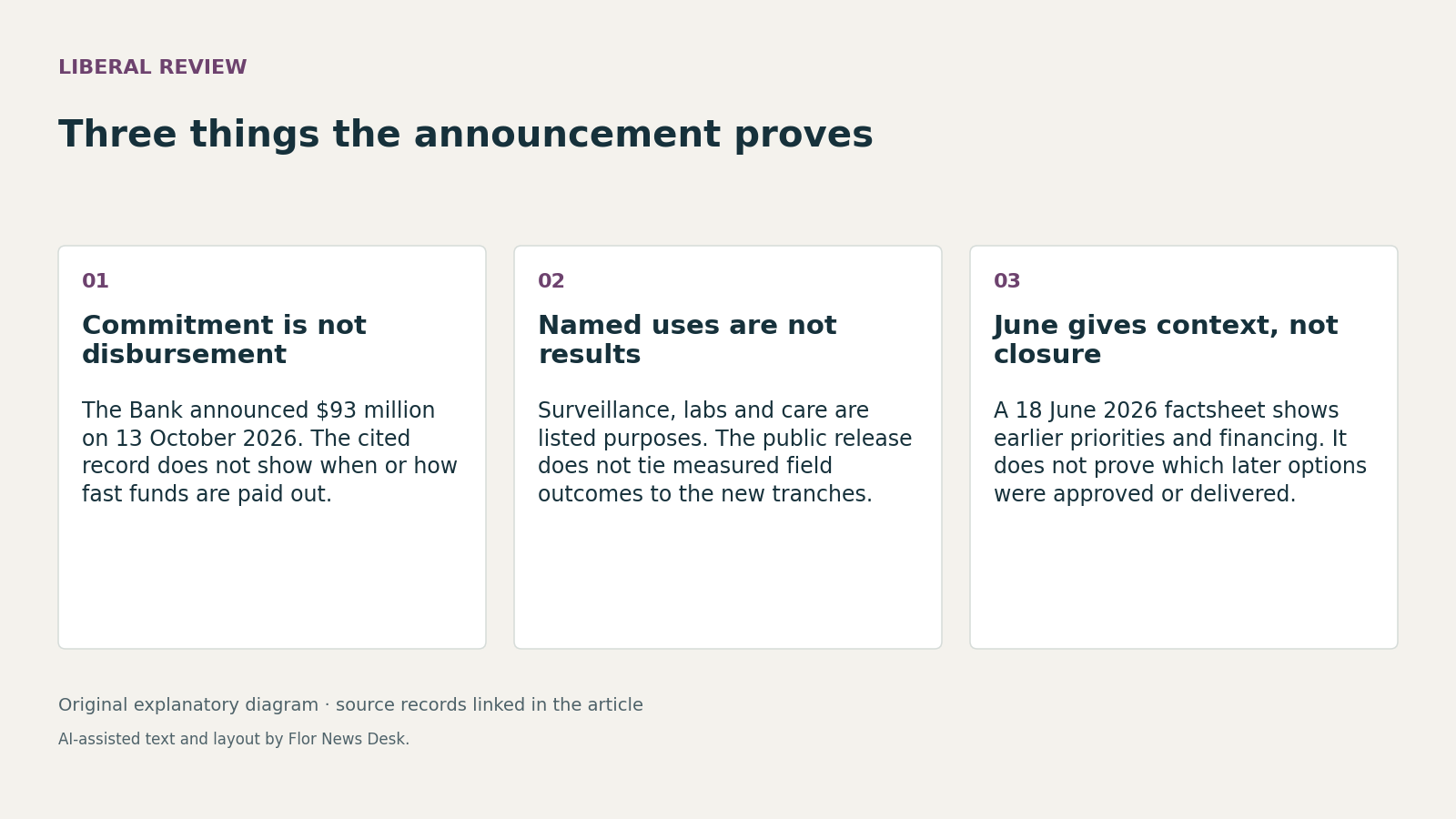
On 13 October 2026, the World Bank Group said it was adding two Ebola-response financing tranches worth $93 million in total: $80 million for the Government of the Democratic Republic of Congo’s national response, and $13 million for neighbouring countries and regional institutions through the Health Emergency Preparedness, Response and Resilience program. That is a real institutional commitment in the public record. It is not, by itself, proof that the money has been disbursed, contracted, or translated into treatment capacity and surveillance on the ground. The distinction matters because the release itself stops at commitment and intended purpose, not verified delivery or measured results from these new tranches (World Bank press release, 13 October 2026).
What the announcement does establish is scope and official intent. The Bank says the $80 million tranche is meant to reinforce surveillance, laboratory capacity, clinical case management, infection prevention and control, and community engagement in affected areas. It says the $13 million regional tranche will support preparedness, coordination and cross-border health security in 11 countries, with technical support roles for the East, Central and Southern Africa Health Community and the Intergovernmental Authority on Development (World Bank press release, 13 October 2026). Those are substantive categories, but still categories. The release does not attach a public disbursement schedule, signed financing instruments, conditions, procurement plans or provincial budgets.
The June 2026 World Bank factsheet helps show why the October announcement is more than a rhetorical reset, but less than a completed response. On 18 June 2026, the Bank said it was making $243 million available for the Ebola outbreak in DRC and Uganda through existing and new financing, and described a response architecture already spanning field deployment, testing capacity, essential maternal and newborn services, and older REDISSE-backed laboratory and emergency-operations investments (World Bank factsheet, published 18 June 2026). Read together, the two Bank records show an expanding official financing picture: the Bank says total committed to the Ebola emergency had reached $426.6 million by 13 October 2026 (World Bank press release, 13 October 2026).
A fair counterargument is that public-health financing cannot wait for perfect documentation before it counts politically. That is true as analysis: authorising money can widen the state’s room to act before every downstream contract appears in public. The Bank also points to claimed earlier HEPRR results, including faster detection by September 2026, deployment of national experts to Bunia, diagnostic platforms, tests, medicines, equipment and surveillance vehicles (World Bank press release, 13 October 2026). But those are still the Bank’s own claims, presented without underlying methodology in the release, and they do not show what the two newly announced tranches have yet accomplished.
That is the article’s central distinction. The October record is evidence of commitment. It is evidence of named priorities. It is evidence that the Bank wants readers to understand the response as both national and regional. It is not evidence, at least in these retrieved records, of when money will leave accounts, which provinces or facilities will receive what shares, what conditions attach to each instrument, or what outcomes can be attributed to the new package rather than to earlier projects and broader partner activity (World Bank press release, 13 October 2026; World Bank factsheet, published 18 June 2026).
So the strongest evidence-led reading, as of 14 October 2026, is cautious. The World Bank has materially enlarged its declared financial commitment to the Ebola emergency. That may prove important. But the public documents retrieved here do not yet let a reader move from announcement to verified implementation, still less to demonstrated impact.
Read our editorial standards or send a correction to the editorial desk.